


Is Moissanite Real? Gemstone, Simulant or Fake Explained
• 6 min read
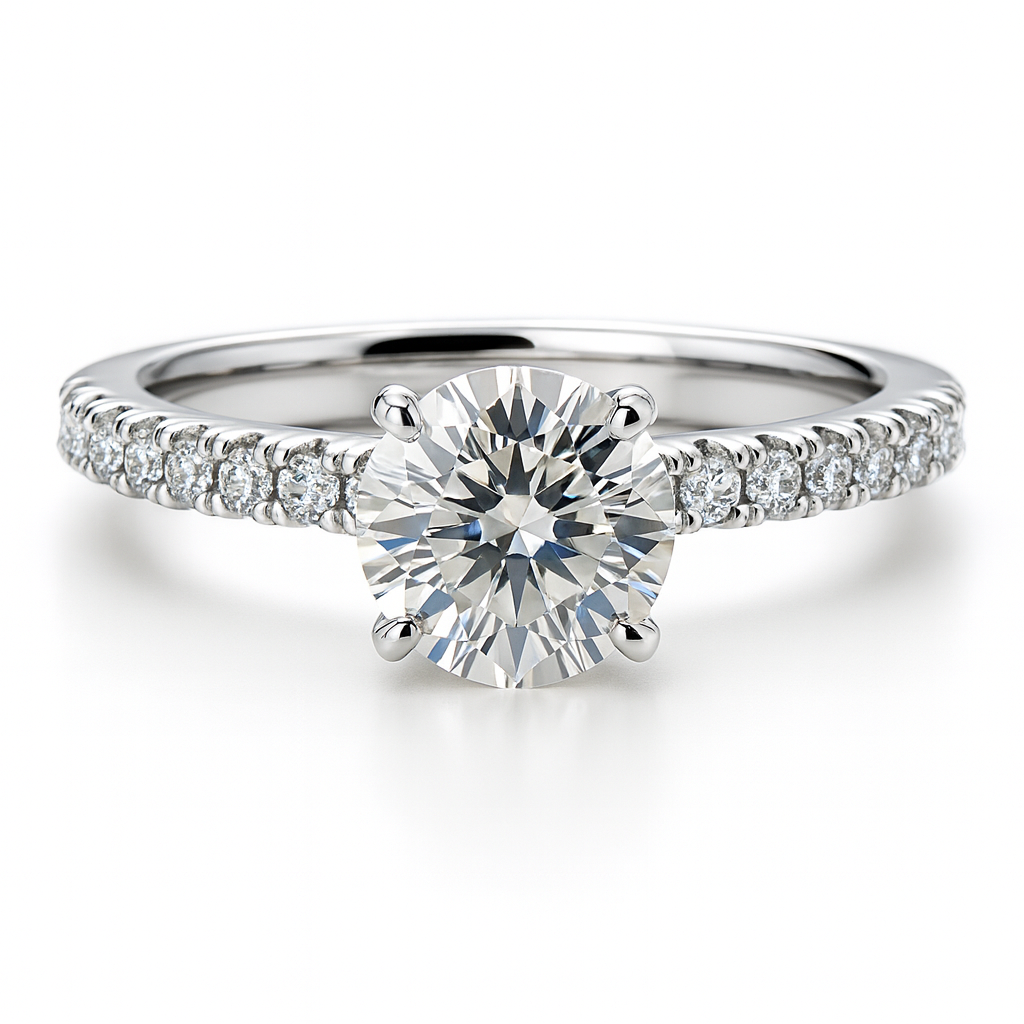
Yes, moissanite is real. It's a genuine gemstone, a mineral called silicon carbide that does occur in nature, though so rarely that all moissanite in jewelry is lab-created. What moissanite isn't is a diamond: it's a different gem with different properties, and when it's set in place of a diamond, it's correctly called a diamond alternative or simulant.
So "is moissanite real or fake?" has a more interesting answer than yes or no. It depends on which word you mean, and the jewelry trade uses several of them. Here's what each one means, and where moissanite fits.
Where moissanite comes from
In 1893 the French chemist Henri Moissan examined crystals found in rock from the Canyon Diablo meteorite site in Arizona. At first he thought they were diamond. Around 1904 they were identified as silicon carbide, and the mineral was later named moissanite in his honor.
Natural moissanite turned out to be extremely rare, found only as tiny grains, never in pieces big enough to cut into jewelry. Gem-quality moissanite became possible once scientists learned to grow large, clear silicon carbide crystals, and it reached the jewelry market in the late 1990s (Charles & Colvard introduced it in 1998). For the longer story, see our introduction to what moissanite is.
Lab-created vs natural: does lab-made mean fake?
No. "Lab-created" (also called lab-grown or synthetic) describes how a stone was made, not whether it's genuine. A lab-created gem has essentially the same chemistry, crystal structure and physical properties as its natural counterpart. Lab-created sapphires and rubies have been used in jewelry for over a century, and lab-grown diamonds are real diamonds.
Lab-created moissanite fits that definition: it's the same silicon carbide as the natural mineral, just grown under controlled conditions in usable sizes. The important thing is disclosure. In the US, the FTC's Jewelry Guides expect lab-made stones to be clearly described with a word like "lab-created," "lab-grown" or "synthetic," and it's misleading to call them "natural." That's why every one of our listings says lab-created or lab-grown moissanite.
Is moissanite a diamond?
No. Diamond is pure carbon. Moissanite is silicon carbide. They look alike in a ring, but they're different materials, and you can see that in their properties:
| Property | Moissanite | Diamond |
|---|---|---|
| Chemistry | Silicon carbide (SiC) | Carbon (C) |
| Hardness (Mohs) | About 9.25 | 10 |
| Refractive index | About 2.65–2.69 | About 2.42 |
| Dispersion ("fire") | About 0.104 | About 0.044 |
| Refraction | Double (facet doubling can show) | Single |
| Density | About 3.21 g/cm³ | About 3.52 g/cm³ |
In practice, moissanite shows more rainbow fire than diamond, it's hard enough for everyday wear, and it's lighter for its size. Our moissanite vs diamond guide covers how those differences look in real life.
The words people use: real, simulant, imitation and more
Much of the confusion comes from terminology. Here's what each term means in the jewelry trade:
- Natural: formed in nature, no human involvement. Natural moissanite exists but isn't used in jewelry.
- Lab-created / lab-grown / synthetic: made in a lab, with essentially the same chemistry and structure as the natural gem. Gem moissanite is lab-created moissanite.
- Simulant: any material used to imitate the look of another gem. When moissanite is set in place of a diamond, it's a diamond simulant. Cubic zirconia and white sapphire are diamond simulants too.
- Imitation: usually means a look-alike with little in common with the original, like glass or plastic. Moissanite is far from that: it's a hard, highly refractive gemstone in its own right.
- DEW (diamond equivalent weight): because moissanite is lighter than diamond, a moissanite the same size as a 1 carat diamond weighs less, roughly 0.85–0.9 carat for a 6.5 mm round. Sellers describe moissanite by the diamond weight it matches in size. When our listings say "1ct (6.5mm)" or "2ct (8mm)," that's diamond-equivalent sizing, and the millimeter figure is the measurement to trust.
So moissanite can be two things at once: a lab-created moissanite, and a diamond simulant. What it shouldn't be called is a diamond. You'll see the phrase "moissanite diamond" online, but it's a misnomer; moissanite isn't a type of diamond.
How moissanite compares to other diamond simulants
Not all simulants are equal. Cubic zirconia (about 8–8.5 on the Mohs scale) can scratch and look cloudy after years of wear. White sapphire (Mohs 9) is durable but has much lower refractive index and fire, so it sparkles less and can look dull when dirty. Moissanite is harder than both and more brilliant than both. Our comparison of moissanite vs cubic zirconia goes into detail.
Why is moissanite so much cheaper if it's real?
People sometimes assume that a lower price means a lesser stone. With moissanite, the price mostly reflects where it comes from, not how good it is. Natural diamonds are mined, and their prices carry the cost and scarcity of mining and a long-established market. Lab-created moissanite is grown to order, so supply isn't limited by what comes out of the ground.
That doesn't make it a lesser material. Its hardness, brilliance and fire are properties of silicon carbide itself, and they're the same whether a stone costs a little or a lot. What does vary between moissanite stones is the quality of the crystal and the cutting: color, clarity, proportions and polish. That's where you should focus when comparing pieces, and it's why sellers describe moissanite with color and clarity grades, just as they would for a diamond.
Lab-grown diamonds have also come down a lot in price in recent years, but moissanite is still usually significantly cheaper, especially at larger sizes.
How to tell genuine moissanite from fakes
Because moissanite has become popular, some sellers label cubic zirconia or glass as "moissanite." A few simple checks help:
- A thermal diamond tester. Genuine moissanite conducts heat well and usually reads "diamond" on a basic thermal tester. CZ and glass fail. A multi-tester, which adds an electrical test, should identify the stone as moissanite. Our article on whether moissanite passes a diamond tester explains both results.
- Clear descriptions. A trustworthy listing names the stone (lab-created moissanite), the size in millimeters, the stated color and clarity, and the metal, including whether it's plated.
- Paperwork. Many moissanite pieces come with a GRA certificate that records the stone's stated grades. It's useful, though it's not the same as a GIA report; see our guide to the GRA moissanite certificate.
- A gemologist. If you want certainty, any qualified gemologist can identify moissanite.
Is moissanite "real jewelry"?
That depends partly on the metal. Our moissanite is set in real 925 sterling silver, and most pieces are plated in 18K or 14K yellow, rose or white gold, or in rhodium. That makes them genuine sterling silver jewelry with genuine lab-created moissanite. They are not solid gold, and we don't describe them that way. Plating can wear over time with friction and chemicals, so it's worth taking pieces off for swimming, the gym and cleaning.
Is moissanite the right choice for you?
Moissanite makes sense if you want a bright, durable, colorless-looking stone at a fraction of what a diamond of the same size can cost. It's a good fit for engagement rings, everyday pieces and gifts.
If what matters most to you is that the stone is a diamond, whether for tradition or personal meaning, then a natural or lab-grown diamond is the honest answer. Neither choice is more "real" than the other. They're different gems, and the right one is the one that fits what you value.
Explore lab-created moissanite
If a classic look appeals, The Signature Ring sets an 8 mm round moissanite on a pavé band, and the Timeless Round-Cut Necklace offers a single solitaire pendant in 5, 6.5 or 8 mm. The Radiance stud earrings come in white and colored moissanite. To see everything in one place, browse the full collection, where every piece is described as lab-created moissanite in sterling silver.
Frequently asked questions
Is moissanite a fake diamond?+
Moissanite isn't a diamond, so it shouldn't be sold as one. But it isn't fake either: it's a genuine gemstone, silicon carbide, with its own hardness, brilliance and fire. When it's used in place of diamond, jewelers call it a diamond alternative or diamond simulant.
Is moissanite natural or man-made?+
Both exist. Natural moissanite occurs in nature but only as tiny, extremely rare grains, so it isn't used in jewelry. All gem moissanite is lab-created, with the same chemistry and crystal structure as the natural mineral.
Is moissanite the same as a lab-grown diamond?+
No. A lab-grown diamond is real diamond made of carbon, just grown in a lab. Lab-created moissanite is a different gem, silicon carbide. They look similar but differ in hardness, refractive index, fire and price, and they're identified differently by testers and labs.
Can people tell my moissanite isn't a diamond?+
Most people can't at a glance, though some notice its extra rainbow fire, especially in sunlight. A jeweler with a multi-tester or loupe usually can tell, and a gemologist always can. That's fine, because moissanite should be described as moissanite anyway.
Is moissanite jewelry real silver or gold?+
That depends on the piece, not the stone. Our moissanite is set in real 925 sterling silver, and most pieces are plated in 18K or 14K gold or rhodium. They are not solid gold, so they're priced and cared for as plated sterling silver jewelry.
Related guides
Latest News
November 2, 2026
November 2, 2026
November 2, 2026
November 2, 2026
November 2, 2026