


Moissanite vs Cubic Zirconia: Durability, Sparkle and Price
• 6 min read
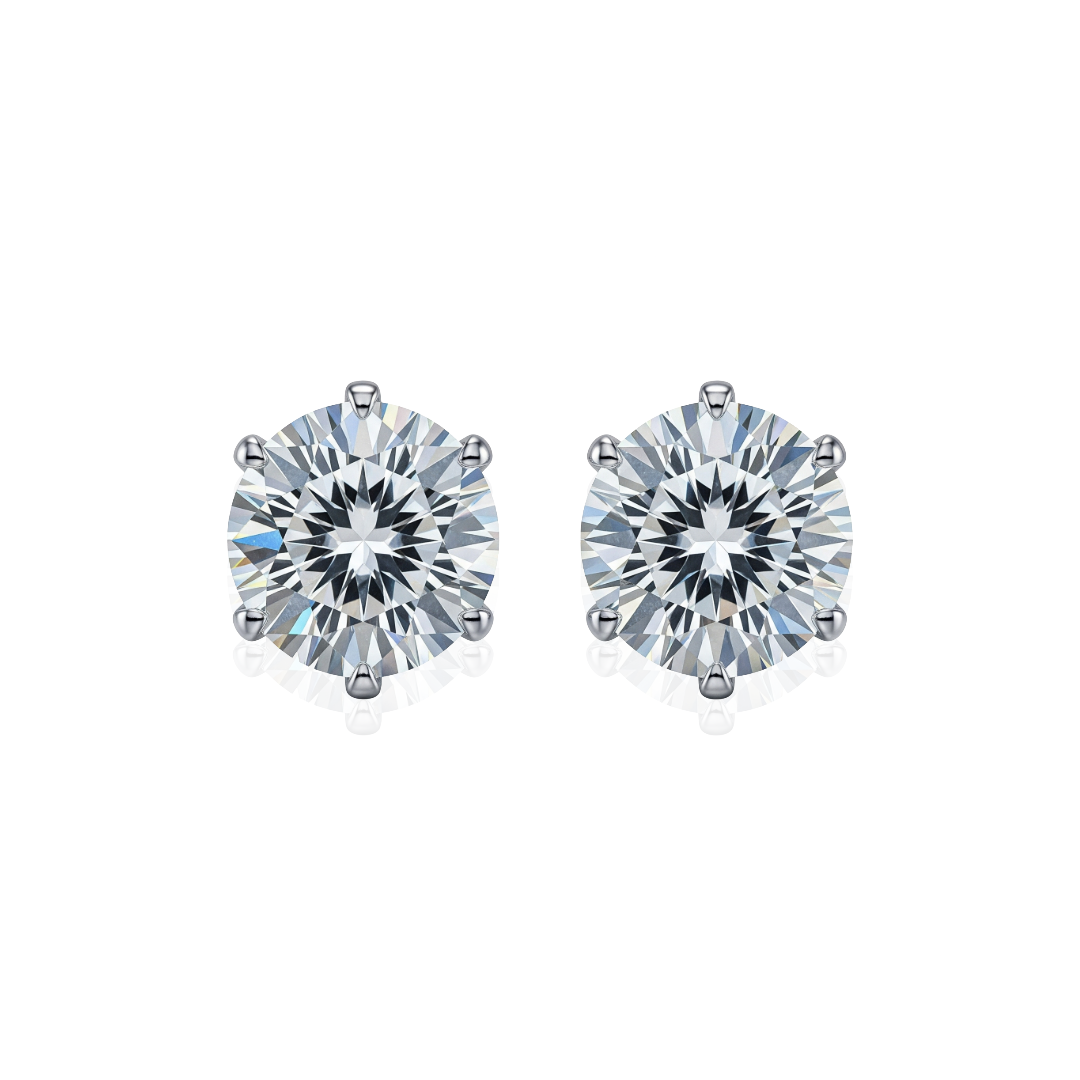
Moissanite and cubic zirconia (CZ) can look alike when both are new, but they age very differently. Moissanite is about 9.25 on the Mohs hardness scale and keeps its sparkle for decades; CZ is about 8 to 8.5 and tends to scratch and cloud over years of wear. CZ costs much less, which makes it fine for fashion pieces, while moissanite is the better choice for jewelry you plan to wear every day.
Here is how the two compare in more detail, and how to decide which one belongs in the piece you have in mind.
Two different lab-made stones
Cubic zirconia is zirconium dioxide grown in its cubic crystal form. It has been mass-produced as a diamond simulant since the 1970s and is now one of the most common stones in fashion jewelry, because it is cheap to make in large quantities and looks bright when new.
Moissanite is silicon carbide. Natural moissanite was first found by Henri Moissan in 1893 in material from the Canyon Diablo meteorite site in Arizona, but natural crystals are extremely rare, so every gem moissanite is lab-created. Gem-quality moissanite reached the jewelry market in the late 1990s. If you are wondering whether that makes it "fake", our article on whether moissanite is real answers that directly.
Both are lab-made and both are used as alternatives to diamond, but they are not the same thing, and they are not in the same price tier.
Moissanite vs cubic zirconia at a glance
| Moissanite | Cubic zirconia | |
|---|---|---|
| Material | Silicon carbide (SiC) | Zirconium dioxide (ZrO₂) |
| Hardness (Mohs) | About 9.25 | About 8–8.5 |
| Refractive index | About 2.65–2.69 | About 2.15 |
| Dispersion ("fire") | About 0.104 | About 0.06 |
| Optics | Doubly refractive | Singly refractive |
| Density | About 3.21 g/cm³ | About 5.6–5.9 g/cm³ |
| Long-term look | Doesn't permanently cloud; residue cleans off | Can scratch and look hazy over years |
| Basic thermal tester | Usually reads as diamond | Does not read as diamond |
| Price tier | Mid: well below diamond | Low: inexpensive |
Durability: the biggest difference
Hardness decides how well a stone resists scratches, and scratches are what slowly take the shine off a gem. Ordinary household dust contains quartz, which sits around 7 on the Mohs scale. Both stones are harder than that, but CZ's margin is small, and years of brushing against surfaces, other jewelry and grit gradually wear its surface and round off its facet edges.
Moissanite, at about 9.25, is harder than sapphire and almost every other gem used in jewelry. Its facets stay sharp, which is what keeps light bouncing cleanly through the stone. That is why moissanite suits engagement rings, eternity bands and daily earrings, while CZ is better thought of as a stone for pieces you rotate or replace.
Sparkle: brightness and fire
Two numbers explain most of the sparkle difference.
- Refractive index measures how strongly a stone bends light. Moissanite's is about 2.65–2.69, CZ's about 2.15. A higher number generally means a brighter stone with more light returned to your eye.
- Dispersion measures how much a stone splits white light into colors, which jewelers call fire. Moissanite's is about 0.104, CZ's about 0.06.
In practice, new CZ looks bright and pretty, especially in small stones. Next to moissanite it looks a little softer and less lively, and the gap grows as the CZ ages. Moissanite has the stronger rainbow flashes of the two, which you notice most in sunlight.
Longevity: how each looks after years
This is where most people's experience of CZ comes from. A CZ ring that looked great in the shop can look foggy a few years later. That's the combination of fine surface scratches and worn facet edges, and cleaning only partly helps because the damage is in the surface itself.
Moissanite doesn't permanently cloud or change color. When it looks dull, it is almost always oils, lotion or soap sitting on the surface, and a proper clean brings it straight back. We cover this in detail in does moissanite get cloudy? and the step-by-step guide to cleaning moissanite.
Weight and feel
CZ is much denser than moissanite (about 5.6–5.9 g/cm³ versus about 3.21). A CZ the same size as a moissanite weighs considerably more. You won't feel that in a tiny stud, but in a large pendant or a ring with a big center stone, CZ can feel noticeably heavier. It also means "carat" figures for CZ and moissanite aren't comparable; it is better to compare millimeter sizes. That is why our listings show sizes like "0.5ct (5mm)" or "1ct (6.5mm)": the carat figure is a diamond-equivalent size, and the millimeters are what you will actually see.
Price tier
CZ is inexpensive; that is its main strength. Moissanite sits in a middle tier: noticeably more than CZ, and usually far less than diamond, including lab-grown diamond. Our moissanite vs lab grown diamond comparison covers that side of the price question.
A useful way to think about cost is cost per year of wear. A CZ piece worn daily may need replacing as it dulls, while moissanite is designed to look the same for a very long time.
Reading a listing honestly
Some jewelry mixes stones, so it is worth reading the spec line, not just the title. As an example from our own catalog, the Imperial Radiance Bangle lists a 1 ct D-color moissanite center and ten 0.3 ct moissanite side stones, plus "premium 5A zircon accents". "5A" is a trade grade usually applied to cubic zirconia, so those small accent stones are not moissanite. We would rather you know that up front.
Watch the wording
Product names can blur the line between stones, so read descriptions carefully. "Diamond simulant" simply means a stone that imitates diamond, and both CZ and moissanite fall into that group. "Lab-grown diamond" should only ever mean actual diamond made in a lab. A trustworthy listing names the stone plainly, whether that is cubic zirconia, moissanite or diamond, and gives sizes in millimeters. If a description is vague about what the stone actually is, ask before you buy.
Who each stone suits
Cubic zirconia makes sense for:
- trend pieces you will wear for a season or two,
- travel jewelry or a stand-in ring for trips,
- trying out a style or stone size before buying something lasting,
- very tight budgets, or jewelry for younger kids who may lose it.
Moissanite makes sense for:
- engagement rings, wedding bands and eternity bands worn daily,
- everyday earrings and pendants you don't want to think about,
- gifts meant to last, rather than to be replaced,
- anyone who wants strong sparkle and top listed color and clarity without diamond prices.
How to tell them apart
If you have a stone and aren't sure which it is:
- Thermal tester. Moissanite usually reads as "diamond" on a basic thermal tester; CZ does not. A multi-tester will identify moissanite as moissanite.
- Weight. A loose CZ feels heavy for its size compared with moissanite.
- Doubling. Moissanite is doubly refractive, so looking through the stone at an angle you may see facet edges doubled, particularly in larger stones. CZ is singly refractive and won't show this.
- Wear. Scratches and rounded facet edges after a few years of wear point toward CZ.
A jeweler can confirm either in moments.
Everyday moissanite pieces to explore
If you have been wearing CZ studs and want something that keeps its sparkle, the Radiance Stud Earrings come in 0.1 ct (3 mm) to 1 ct (6.5 mm) sizes, with four- or six-prong settings. The Solitaire Icon Necklace is a simple round pendant from 0.5 to 2 ct, and the Eterna Moissanite Eternity Band sets 2 mm round stones all the way around. Our stud earrings size guide helps with choosing a size. For more daily pieces, the Everyday Sparkle collection and the full earrings collection are good places to start. Our settings are 925 sterling silver with gold or rhodium plating, so take them off for swimming, the gym and cleaning to keep the finish looking its best.
Frequently asked questions
Is moissanite the same as cubic zirconia?+
No. Moissanite is silicon carbide and cubic zirconia is zirconium dioxide. They are different materials with different hardness, sparkle and weight. Both are lab-made, but moissanite is much harder and keeps its look far longer.
Does cubic zirconia get cloudy?+
It can, over years of wear. CZ is about 8 to 8.5 on the Mohs scale, so everyday dust and contact slowly scratch its surface and soften its facet edges, which makes it look hazy. Moissanite, at about 9.25, resists that kind of wear far better, and any dullness on it is surface residue that cleans off.
Which sparkles more, moissanite or cubic zirconia?+
Moissanite. It has a higher refractive index (about 2.65 to 2.69 versus about 2.15) and stronger dispersion, so it looks brighter and shows more rainbow fire. New CZ sparkles nicely, but side by side moissanite looks livelier.
How can you tell moissanite from cubic zirconia?+
A basic thermal diamond tester is one quick way: moissanite usually reads as diamond, while CZ does not. CZ is also much heavier for its size, and moissanite may show facet doubling when viewed at an angle because it is doubly refractive. A jeweler can confirm either one easily.
Is cubic zirconia a good choice for an engagement ring?+
It can work as a placeholder or a travel ring, but it is not ideal for decades of daily wear because it scratches and clouds over time. For a ring worn every day, moissanite or diamond holds up much better.
Related guides
Latest News
November 2, 2026
November 2, 2026
November 2, 2026
November 2, 2026
November 2, 2026