


GRA Moissanite Certificate: What It Is and How to Read It
• 6 min read
A GRA moissanite certificate is a small grading card or report that commonly comes with moissanite. It lists the stone's stated shape, measurements, weight, color, clarity and cut, usually with a report number you can look up. It's useful as a record of what the seller says you're getting. It is not a GIA report, it isn't an independent lab grading of GIA's standing, and it isn't an appraisal of the stone's value.
That's the core of it. Below is how to read one, how report numbers and laser inscriptions work, and how to use the card sensibly.
What GRA is (and why it's not GIA)
GRA reports are widely issued across the moissanite trade, and they're typically requested by the suppliers and sellers of the stones. If you've shopped for moissanite online, you've almost certainly seen the cards: credit-card-sized, with a photo of a stone and a list of grades.
The letters cause a lot of confusion. GIA, the Gemological Institute of America, is an independent lab known for grading diamonds, and IGI is another lab widely used for diamonds and lab-grown diamonds. GRA is not affiliated with GIA, and a GRA card shouldn't be read as carrying the same weight. Major diamond labs identify moissanite, but they don't issue color and clarity grades for it the way they do for diamonds. That's part of why GRA-style cards became the norm for moissanite.
We can't speak for how every card is produced across the industry. What we can say is how to read one and what it's good for.
What's on a GRA card
Layouts vary, but a typical card includes:
- Report number, often with a QR code
- Shape and cut style, such as round brilliant or oval
- Measurements in millimeters
- Weight in carats
- Color grade, usually on the D-to-Z scale
- Clarity grade, such as VVS1
- Cut, polish and symmetry grades
- A photo of a stone and sometimes a date
How to read it, field by field
| Field | What it tells you | What to check |
|---|---|---|
| Report number | The record's ID | Matches any online record and any inscription on the stone |
| Shape / cut | The stone's outline and facet style | Matches the piece you ordered |
| Measurements | Physical size in mm | The most useful number; compare it with the listing |
| Weight | Stated carats | Moissanite is lighter than diamond; see the note below |
| Color | Stated color grade | D–F is colorless; matters most in larger stones |
| Clarity | Stated clarity grade | VVS and VS are normally eye-clean |
| Cut, polish, symmetry | Stated finish quality | "Excellent" is the usual top grade |
A note on carats. Moissanite is less dense than diamond (about 3.21 g/cm³ vs about 3.52), so a moissanite the same size as a 1 carat diamond weighs a little less, roughly 0.85–0.9 carat for a 6.5 mm round. Sellers usually describe moissanite by diamond equivalent weight (DEW), the diamond weight it matches in size. That's how our listings work: "1ct (6.5mm)" means a stone the size of a 1 carat diamond. When you're comparing, trust the millimeter measurement most. Our moissanite carat size chart shows the common sizes.
For what grades like D and VVS1 actually mean, and how much they matter at different sizes, see our guide to moissanite color and clarity grades.
What a GRA certificate isn't
Being clear about the limits makes the card more useful, not less:
- It isn't a GIA or IGI report. It's a separate document, and its grades are best understood as the stone's stated grades.
- It isn't an appraisal. It doesn't state a retail, replacement or insurance value. If you want to insure a piece, ask an independent appraiser, and make sure the appraisal names the stone as lab-created moissanite.
- It isn't proof on its own that the card belongs to your stone. An online lookup confirms the report record exists. Matching that record to the stone in your hand takes measurements, an inscription check, or a jeweler.
- It isn't an investment document. Moissanite is a beautiful, durable gemstone to wear and enjoy, not something to buy for resale.
Report numbers, lookups and laser inscriptions
Most GRA cards carry a report number, and many include a QR code that opens an online record. When you check one, compare the record with both the card and your stone: shape, measurements and grades should all line up.
Some moissanite also has a tiny report number laser-inscribed on the girdle, the thin outer edge of the stone. It's far too small to read with the naked eye; you'll need a 10x loupe or a jeweler's microscope, and in a closed or bezel setting it may be hidden. If your stone has an inscription and it matches the card and the online record, that's a good consistency check.
Paperwork is never the final word, though. Inscriptions can be faked: GIA has published a lab note about a synthetic moissanite inscribed with a number copied from a natural diamond's GIA report. That's a reminder that identifying a stone comes down to examining the stone itself. A thermal tester, a multi-tester and a gemologist's loupe tell you what you have; our article on whether moissanite passes a diamond tester explains what each one shows.
Questions worth asking about any GRA card
Whether you're buying from us or anyone else, a few questions help you get the most out of a certificate:
- Is the card for this specific stone? A card that describes the exact stone in your piece is more useful than a generic one for the style.
- Is the weight actual or diamond-equivalent? Sellers handle this differently, so ask if the carat figure and the millimeter size don't seem to match what you expect.
- Do the measurements match the listing? The millimeter size on the card should agree with the size you ordered, within normal tolerances.
- Is the stone inscribed? If it is, you or a jeweler can check that the number matches the card.
- What does the card not cover? A GRA card describes the stone only. It says nothing about the metal, the plating, or how well the stone is set. For our pieces, the metal is 925 sterling silver, most often plated in gold or rhodium, and that's stated on each product page, not on the certificate.
A seller who answers these plainly is giving you a good sign about how they describe the rest of their jewelry.
Why the card is still worth having
A GRA certificate does several useful things:
- It documents the promise. You have the stated size and grades in writing, which you can compare against the listing.
- It helps you describe your stone. If you ever need a repair or resizing, a jeweler appreciates knowing the stone is moissanite and its measurements. (Moissanite can also react temporarily to a jeweler's torch, so it's worth mentioning.)
- It supports clear labeling. A card that names the stone as moissanite reinforces that it's sold as what it is, which matters to us. See our explainer on whether moissanite is real for more on the terms.
Keep the card with the jewelry box, and take a photo of both sides for your records.
Our GRA certificates
Eligible items in our store come with a GRA moissanite certificate. If having a certificate matters for a particular piece, email service@furmanluxury.com before ordering and we'll confirm it for you. Keep the certificate with the original packaging: if you return an eligible item within our 14-day window, it needs to come back unworn with its packaging and certificate. The details are in our return policy.
Solitaire pieces where the center stone takes the spotlight
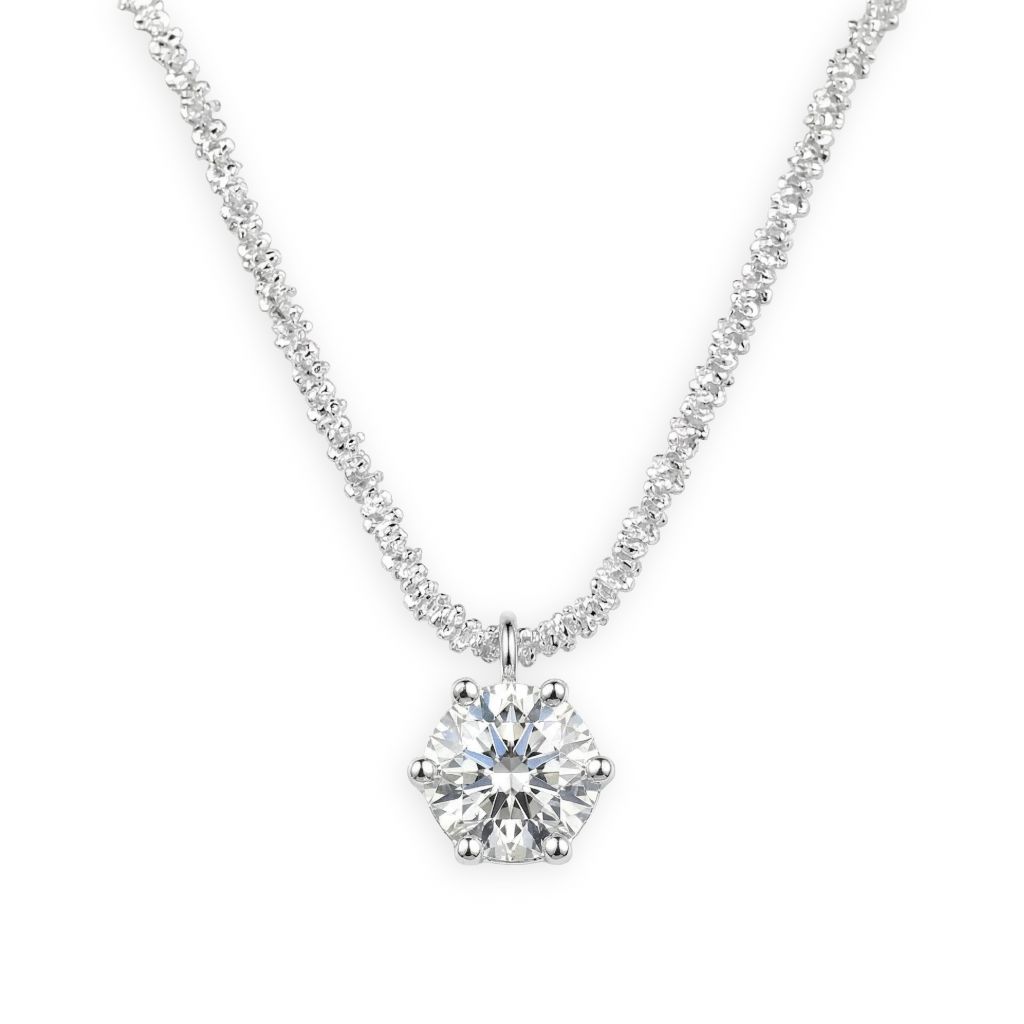
Certificates are most meaningful for a single, prominent stone. The Timeless Round-Cut Necklace features one round moissanite in 5, 6.5 or 8 mm, the Floré Magen pendant centers a 1 carat diamond-equivalent stone, and The Signature Ring sets a 2 ct (8 mm) round center on a pavé band. You'll find more single-stone designs in our Timeless Classics collection.
Frequently asked questions
Is a GRA moissanite certificate legit?+
A GRA card is a real and widely used document in the moissanite trade, and it's a useful record of a stone's stated measurements and grades. It isn't an independent lab report of GIA's standing, and it isn't an appraisal. Think of it as documentation of what you were sold, not a guarantee of value.
Is GRA the same as GIA?+
No. GIA is the Gemological Institute of America, an independent lab best known for grading diamonds. GRA reports are a separate kind of document issued for moissanite, usually requested by suppliers and sellers. The similar letters cause confusion, but they're not related.
Does a GRA certificate add value to moissanite?+
Not in a financial sense. It doesn't state a retail, resale or insurance value, and moissanite shouldn't be thought of as an investment. Its value is practical: it documents the stone's stated size and grades, which helps you compare pieces and describe your stone to a jeweler.
How do I verify a GRA certificate?+
Most cards carry a report number and often a QR code that leads to an online record. Check that the record's shape, measurements and grades match the card and your stone. If the stone has a laser-inscribed number, a jeweler with a loupe can confirm it matches. A lookup confirms the record exists, not that the card belongs to your stone.
What should I do if I lose my GRA card?+
Keep a photo of the front and back of the card when your jewelry arrives, so you have the report number on file. The card isn't needed to wear or care for the jewelry. Keep the original with the packaging, since a return of an eligible item needs to include the certificate.
Related guides
Latest News
November 2, 2026
November 2, 2026
November 2, 2026
November 2, 2026
November 2, 2026