


Oval Moissanite Engagement Rings: How to Choose the Right One
• 6 min read
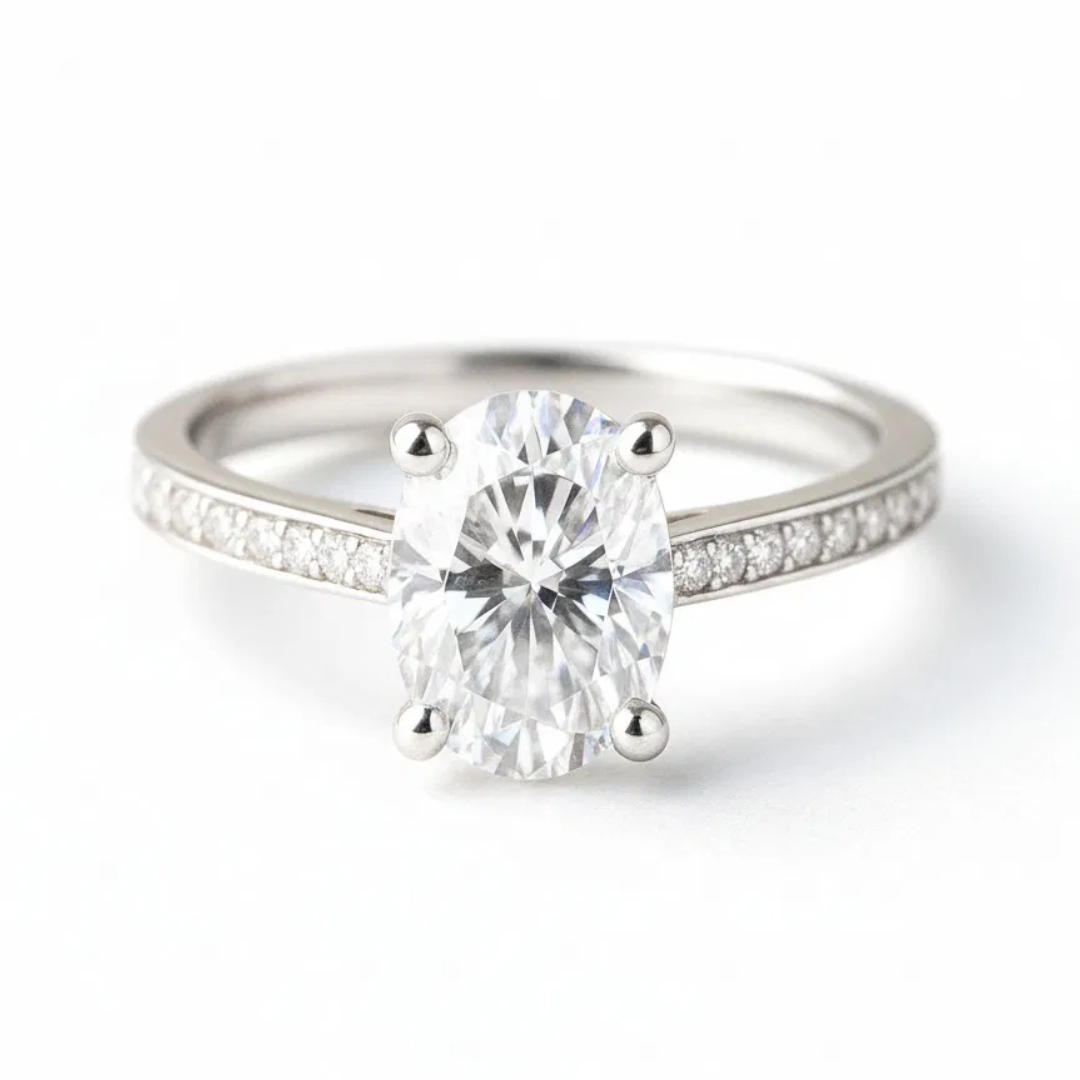
An oval moissanite engagement ring gives you the sparkle of a brilliant cut in a longer, more flattering shape. Ovals tend to look larger than a round stone of similar weight, they make fingers look longer, and moissanite's high brilliance suits the cut well. The things to check are the length-to-width ratio, how strong the bow-tie is, and which setting fits your style.
Why oval moissanite looks larger
Two things are going on. First, an oval spreads its weight over a longer outline, so a lot of the stone is visible from the top. Compared with a round of similar weight, it generally covers more of the finger. Second, the elongated shape pulls the eye along the length of the finger, so the hand looks slimmer and the stone looks more generous.
Moissanite adds its own advantage. Because it is sold by millimeter size and diamond-equivalent weight, you are choosing the outline you will actually see, and a bigger look costs far less than it would with diamond. Moissanite is also lighter than diamond (about 3.21 g/cm³ against 3.52), so a stone with the face-up size of a 2 carat diamond actually weighs a bit less. Our moissanite carat size chart explains diamond-equivalent sizing in more detail.
The bow-tie effect, explained
Look at photos of oval stones and you will often see a darker, bow-tie-shaped band running across the middle. This happens in most elongated brilliant cuts (ovals, pears and marquises). Because the stone is longer in one direction, some facets in the middle send less light back toward your eye at certain angles.
A few points to keep in mind:
- Some bow-tie is normal. A faint shadow that comes and goes as the ring moves gives the stone contrast and character.
- A strong, fixed dark band is the problem. It usually points to shallow or uneven faceting.
- Moissanite helps. With a refractive index of about 2.65 to 2.69 (diamond is about 2.42), moissanite returns a lot of light, which tends to keep the center bright.
- Judge in motion. A still photo under one light can exaggerate a bow-tie. Videos, or the ring on the hand in daylight, show what you will actually see.
Elongation ratio: choosing your outline
The length-to-width ratio is simply the stone's length divided by its width. A 9×7 mm oval, like the center of our oval Solitaire Engagement Ring, has a ratio of about 1.29.
| Ratio | Look | Who tends to like it |
|---|---|---|
| about 1.2–1.3 | fuller, softer, closer to round | people who want a gentle oval that still looks substantial |
| about 1.3–1.5 | the classic oval | most buyers; balanced on most finger sizes |
| about 1.5 and up | slim and dramatic | long fingers, or anyone who loves an elongated, vintage feel |
Many people find the 1.3 to 1.5 range the most classic, but this is pure preference. If you can, compare a few photos of rings on hands and notice which outline you keep coming back to.
Oval settings and our oval rings
The setting changes an oval's personality more than you might expect. Here are the three oval styles in our collection.
Classic solitaire: Luna Oval Cut Engagement Ring
The Luna Oval Cut Engagement Ring is a clean oval solitaire, the most timeless way to wear the cut. With nothing around the center, the stone's shape does all the talking. Luna comes in 1, 2, 3 or 4 carat diamond-equivalent sizes, with white, yellow or rose gold plating over 925 sterling silver and a protective coating, in US sizes 5 to 9. It starts from $349.99 at the time of writing. A solitaire like this is also the easiest style to pair with a wedding band later.
Vintage side stones: Vintage Oval Elegance
Vintage Oval Elegance frames the oval with a vine of marquise and round side stones that are larger and more spaced out than a typical pavé band. The effect is romantic and slightly Victorian, and the side stones widen the overall look of the ring. It comes with a 1 or 2 carat oval center in 18K gold-plated sterling silver, in US sizes 4 to 9.5 including half sizes.
Hidden halo and pavé: Solitaire Engagement Ring (oval)
Our Solitaire Engagement Ring uses a 2 carat (9×7 mm) oval center with pavé stones along the upper band and a row of small stones around the base of the center stone. From the top it reads as a solitaire; from the side you catch an extra line of sparkle. It is plated in 14K white, yellow or rose gold and offered in US sizes 4 to 10.
Quick comparison
| Ring | Style | Center size options | Plating colors |
|---|---|---|---|
| Luna Oval Cut | plain solitaire | 1, 2, 3, 4 ct look | white, yellow, rose |
| Vintage Oval Elegance | vintage side stones | 1, 2 ct look | 18K gold plated |
| Solitaire Engagement Ring | pavé band, hidden-halo detail | 2 ct (9×7 mm) | white, yellow, rose |
If you are deciding between a plain look and extra sparkle around the center, our halo vs solitaire engagement ring comparison may help.
Practical tips for buying an oval
Orientation. Traditional ovals are set north-south, with the long side running along the finger. That is the most flattering for most hands and is how our oval rings are designed.
Size for your finger. An oval that extends beyond the sides of a slim finger can look top-heavy. On sizes 4 to 6, a 1 or 2 carat look is usually ample; larger fingers carry 3 or 4 carats comfortably.
Prongs protect the tips. The narrow ends of an oval are the most exposed part of the stone. Moissanite is hard (about 9.25 on the Mohs scale), but any stone can chip from a sharp knock on an exposed point. Check now and then that the prongs still sit snugly.
Metal color. White gold plating gives a crisp, icy look; yellow and rose plating warm the stone up. Remember that our rings are gold-plated 925 sterling silver, not solid gold, so plating can wear with daily friction. Our gold-plated sterling silver guide explains how to slow that down and when to re-plate.
Cleaning. Ovals collect lotion and skin oil under the stone like any ring, which can make the center look dull and the bow-tie darker. A soft brush and mild soapy water bring it right back; see how to clean moissanite.
For a broader look at shapes, read the best cut for moissanite, and for size, metal and budget in one place, see our moissanite engagement ring guide.
Oval vs other elongated shapes
If you like the idea of an elongated stone, it is worth knowing how the oval compares with its neighbors.
| Shape | Look | Bow-tie | Points to protect |
|---|---|---|---|
| Oval | soft, balanced, brilliant sparkle | often a light one | none sharp; the two ends are the most exposed |
| Pear | teardrop, romantic, a little vintage | can show one | the pointed tip |
| Marquise | long and dramatic | can show one | two pointed tips |
| Emerald | step-cut, broad mirror-like flashes | no | the corners are cut off, which helps protect them |
The oval is the easiest elongated shape to live with: no sharp points, plenty of sparkle and a flattering outline. Pears and marquises are more dramatic but need careful prong protection at the tips. Emerald cuts trade sparkle for clean geometry, as in the Lumière Royale Emerald Ring.
Is an oval right for you?
Choose an oval if you want a stone that looks generous without being flashy, flatters the hand and feels both classic and current. If you prefer the maximum sparkle and symmetry of a perfect circle, a round solitaire such as The Signature Ring, a 2 ct (8 mm) round on a pavé band, may suit you better.
Explore oval and other engagement rings
You can see all three oval designs, along with our round, emerald and radiant styles, in the engagement rings collection. For promise and anniversary rings as well, browse Love & Proposals. Shipping is free worldwide. Since wrong-size returns aren't accepted, measure carefully with our guide to measuring ring size at home before you order.
Frequently asked questions
Does an oval moissanite look bigger than a round one?+
Usually, yes. An oval spreads its weight over a longer outline, so it tends to cover more of the finger face-up than a round stone of similar weight. The elongated shape also draws the eye along the finger, which adds to the impression of size.
Do all oval moissanites have a bow-tie?+
Most elongated brilliant cuts show at least a faint darker band across the middle at some angles, because of how light travels through the stone. A well-cut oval keeps it soft, and moissanite's high brilliance tends to keep the center lively. A heavy, sharply dark bow-tie is a sign of a weaker cut.
What is the best length-to-width ratio for an oval engagement ring?+
Many people find a ratio of roughly 1.3 to 1.5 the most classic. Lower ratios look fuller and rounder; higher ratios look slimmer and more dramatic. There is no correct answer, only the outline you like best on your own hand.
Should an oval engagement ring be set north-south or east-west?+
North-south, with the long side running along the finger, is the traditional choice and makes the finger look longer. East-west, with the stone set sideways, is a more unusual modern look that sits lower across the hand. Our oval rings are designed north-south.
Are oval moissanite rings good for small hands?+
Ovals suit small hands well because the elongated shape lengthens short fingers. On a smaller finger, a 1 or 2 carat look is usually plenty; very large ovals can extend past the sides of a slim finger.
Related guides
Latest News
November 2, 2026
November 2, 2026
November 2, 2026
November 2, 2026
November 2, 2026