


Does Moissanite Pass a Diamond Tester? An Honest Answer
• 6 min read
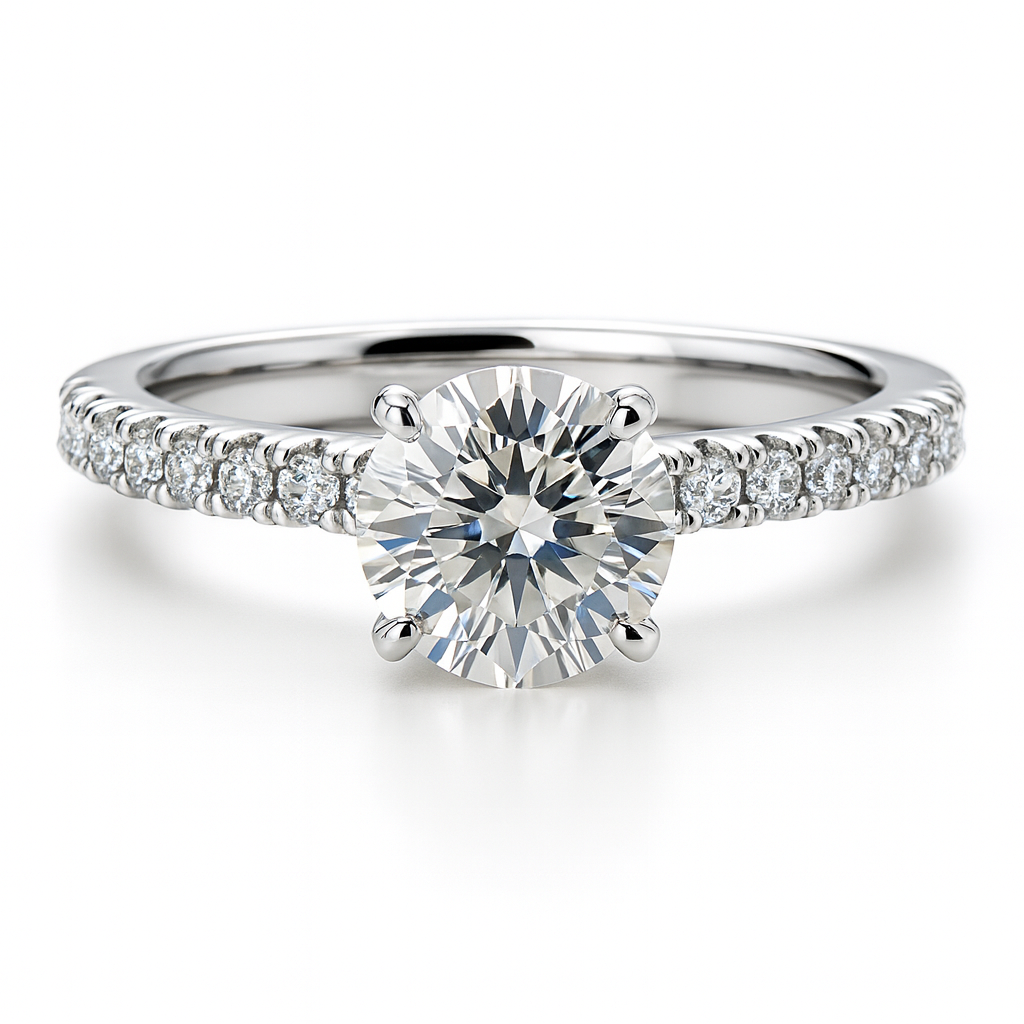
On a basic thermal diamond tester, moissanite usually does pass: it conducts heat well enough that many of these pens light up "diamond." On a multi-tester or a dedicated moissanite tester, which also checks electrical conductivity, it doesn't — the device will identify it as moissanite. And whatever a handheld tester says, a trained jeweler or gemologist can tell moissanite and diamond apart.
That's the short version. Below is how each kind of tester works, the rare cases where testers get it wrong, and what the tester video on our homepage does and doesn't show.
Why moissanite fools a basic thermal tester
The classic pen-style diamond tester has a fine metal tip that is slightly warmed. When you touch it to a stone, the device measures how quickly heat flows away from the tip. Diamond is an exceptional conductor of heat, far better than most gems, so heat drains away fast and the tester reads "diamond."
These testers were designed to separate diamond from the simulants that dominated the market before the late 1990s: cubic zirconia, glass, white sapphire and similar stones. All of those are poor heat conductors, so they fail the test.
Moissanite arrived as a gem material in the late 1990s, and it conducts heat very well too. It isn't as conductive as diamond, but it lands in the range a basic thermal tester treats as "diamond." In other words, a thermal tester really answers the question "Does this stone conduct heat like diamond?" rather than "Is this a diamond?"
How multi-testers and moissanite testers catch it
Moissanite is silicon carbide, a material that conducts some electricity. Most diamonds are electrical insulators. Testers built to catch moissanite add an electrical conductivity check, often alongside the thermal test in one device (these are usually sold as multi-testers):
- If the stone passes the thermal test and does not conduct electricity, the tester reads diamond.
- If the stone passes the thermal test and does conduct electricity, the tester flags moissanite.
- If the stone fails the thermal test, it's neither — likely CZ, glass, white sapphire or another simulant.
To get a reliable reading on any tester, the stone should be clean and dry, the device warmed up or calibrated as its instructions say, and the probe held square against a facet (usually the table). If the probe touches the metal setting, many testers sound a metal alert or give a false result. Very small stones, like the 1–2 mm accents in pavé and tennis pieces, are harder to test accurately.
The type IIb diamond caveat
Electrical testers have one well-known blind spot. A small group of diamonds contain boron, which makes them conduct electricity. Gemologists call these type IIb diamonds; they are rare in nature and often have a blue or gray tint (the famous Hope Diamond is one). Some lab-grown diamonds can contain boron as well.
Because they conduct electricity, these diamonds can trigger the moissanite alert on an electrical tester. So even a multi-tester isn't a final verdict. It's a quick screening tool, and the definitive answer comes from gemological examination.
Diamond tester types at a glance
| Tester type | What it measures | Moissanite | Most diamonds | CZ, glass, white sapphire |
|---|---|---|---|---|
| Basic thermal tester | How fast heat leaves the tip | Usually reads "diamond" | Reads "diamond" | Fails |
| Electrical / moissanite tester | Whether the stone conducts electricity | Flags moissanite | Doesn't conduct (boron-containing diamonds can) | Doesn't conduct |
| Multi-tester (thermal + electrical) | Both of the above | Identifies moissanite | Reads "diamond" (rare boron diamonds may flag) | Fails thermal test |
| Gemologist and lab instruments | Optical, physical and spectral properties | Identified reliably | Identified, including natural vs lab-grown | Identified |
What a jeweler or gemologist actually uses
A handheld tester is a convenience. An experienced jeweler has several other ways to separate moissanite from diamond, and most of them don't need any electronics.
Double refraction. Moissanite is doubly refractive: light entering it splits into two rays. Look through the stone at an angle with a 10x loupe, and the back facet edges can appear doubled, a bit like a slightly blurred double image. Diamond is singly refractive and shows sharp, single facet edges. Cutters usually orient moissanite so that doubling is minimal when you look straight down through the table, which is why a jeweler tilts the stone and looks from the side.
Fire. Moissanite's dispersion is about 0.104, compared with about 0.044 for diamond, so it throws noticeably more rainbow flashes, especially in sunlight or under spotlights. A trained eye picks this up quickly. If you want the full side-by-side, our moissanite vs diamond comparison covers it.
Inclusions. Under magnification, moissanite often shows tiny needle-like or thread-like inclusions that look different from the crystals, feathers and clouds typical of diamond.
Weight for size. Moissanite is lighter than diamond (density about 3.21 g/cm³ vs about 3.52). A loose 6.5 mm round moissanite looks like a 1 carat diamond but weighs roughly 0.85–0.9 carat. That's why moissanite is sold by millimeter size or "diamond equivalent weight," as our listings do with sizes like "1ct (6.5mm)."
Lab equipment. Gem labs use spectroscopy and other advanced instruments that identify moissanite, natural diamond and lab-grown diamond with confidence, including the boron-containing diamonds that confuse electrical testers.
What the tester video on our homepage shows
Our homepage includes a short video of one of our moissanite stones on a diamond tester, and it reads "diamond." Here's what that does and doesn't mean, plainly:
- What it shows: the stone conducts heat the way diamond does. That rules out cubic zirconia, glass and white sapphire, all of which would fail. It's a quick demonstration that you're getting genuine moissanite, not a cheaper look-alike.
- What it doesn't show: that the stone is a diamond. It isn't, and we never describe it as one. On a multi-tester or moissanite tester, the same stone would be identified as moissanite, and any gemologist would identify it as moissanite too.
Every piece we sell is described as lab-created moissanite, and eligible items come with a GRA moissanite certificate. If you're curious what that card does and doesn't tell you, see our guide to the GRA moissanite certificate.
Please don't use moissanite to pass as diamond
It's worth saying clearly: moissanite should always be presented as moissanite. Selling, pawning, trading or gifting it as a diamond is dishonest, can be fraud, and won't hold up anyway, since jewelers, pawn shops and appraisers routinely use multi-testers and loupes. If you're giving moissanite as a gift or engagement ring, tell the recipient what it is. If you have it appraised or insured, make sure the paperwork names it correctly.
The good news is that moissanite doesn't need a cover story. It's a real gemstone with its own properties: about 9.25 on the Mohs hardness scale, more fire than diamond, and a price that leaves room in the budget. Our article on whether moissanite is real goes into what "real" means here.
What this means if you're buying moissanite
If you or a friend test your moissanite, expect a thermal tester to say "diamond" and a multi-tester to say "moissanite." Both results are normal, and together they confirm you have genuine moissanite.
A tester won't tell you anything about quality. For that, look at the stone's color and clarity grades, its cut and its size in millimeters. Our guide to moissanite color and clarity grades explains what grades like D color and VVS1 clarity mean, and how much they matter at different stone sizes.
Find a stone you'll love for what it is
If you're looking at a classic round solitaire, The Signature Ring pairs a 2 carat diamond-equivalent (8 mm) round center stone with a pavé band. For an elongated shape, the Luna oval cut engagement ring is a good place to start. You can browse every option in our engagement rings collection, all set in gold-plated 925 sterling silver and all clearly described as lab-created moissanite.
Frequently asked questions
Will a jeweler know my ring is moissanite?+
Usually, yes. Most jewelers keep a multi-tester that flags moissanite, and a trained eye with a loupe can often spot the facet doubling and strong rainbow fire that moissanite shows. A gemologist with lab instruments can always tell the two apart.
Can a diamond tester damage moissanite?+
No. Handheld thermal and electrical testers use a gently warmed tip and a very small current, and moissanite is a hard, heat-stable stone. The usual care applies: clean the stone first and press the probe gently rather than scraping it across the facets.
Why did a tester say my diamond was moissanite?+
The most common reasons are the probe touching metal, a dirty stone, or an uncalibrated device. More rarely, the diamond contains boron (a type IIb diamond, or some lab-grown diamonds), which conducts electricity and can trigger the moissanite alert. A gemological lab can settle it.
Does passing a diamond tester mean my moissanite is high quality?+
No. Any genuine moissanite conducts heat well, so a thermal tester only tells you the stone is moissanite rather than glass or cubic zirconia. It says nothing about color, clarity or cut, which you judge by eye and from the stone's stated grades.
Will cubic zirconia pass a diamond tester?+
No. Cubic zirconia is a poor conductor of heat, so it fails a basic thermal diamond tester. That's one reason the thermal test is still useful: it quickly separates moissanite and diamond from cheaper simulants like CZ and glass.
Related guides
Latest News
November 2, 2026
November 2, 2026
November 2, 2026
November 2, 2026
November 2, 2026