


Moissanite Color and Clarity Grades: What D and VVS1 Mean
• 6 min read
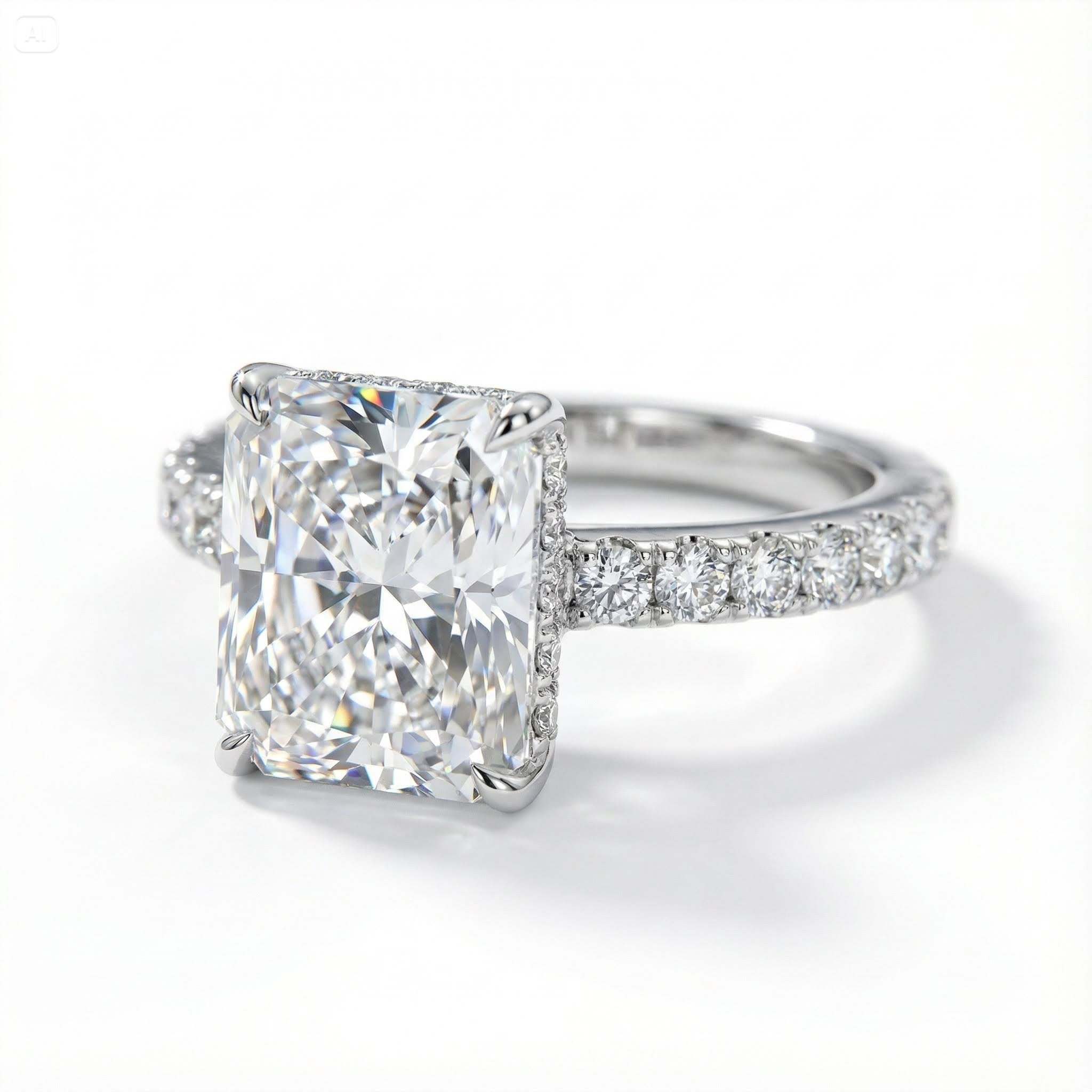
Moissanite sellers grade their stones using the familiar diamond scales: D to Z for color and FL to I for clarity. D is the top colorless grade, and VVS1 means any inclusions are extremely difficult to see even under 10x magnification. These grades are usually assigned by the seller or supplier rather than by a diamond lab like GIA, and because modern moissanite is generally produced near-colorless and very clean, the grade matters less than size, cut and setting, though it matters more as stones get bigger.
Here's what the grades mean, where they come from, and how to decide how much to care about them.
Where moissanite grades come from
The D-to-Z color scale and the FL-to-I clarity scale were developed for diamonds and are used by labs like GIA and IGI. Moissanite sellers adopted them because shoppers already understand them: "D color, VVS1" instantly signals "top of the range."
There are two things to keep in mind. First, major diamond labs identify moissanite, but they don't grade its color and clarity the way they grade diamonds. The grades you see on moissanite come from the seller or its supplier, often recorded on a GRA report. Our guide to the GRA moissanite certificate explains what that report is and isn't. Second, some moissanite brands use their own tier names instead of letters. Either way, the grade is a description of the stone, not an independent lab's verdict.
Moissanite color grades: D, E, F and beyond
Color grades describe how much body color a stone has when viewed face-down against a white background, before the sparkle gets in the way.
| Grade | What it means | What you'll typically see |
|---|---|---|
| D | Colorless, top grade | Icy white |
| E–F | Colorless | White; essentially indistinguishable from D once set |
| G–H | Near-colorless | Looks white face-up in most settings; slight warmth side by side with D |
| I–K | Near-colorless to faint tint | Faint warmth, more visible in larger stones and white metal |
Moissanite's color is a little different from diamond's. In diamond, faint color is usually yellowish. In moissanite, especially older stones, it could lean yellowish, greenish or grayish. So the diamond scale is an approximation for moissanite, and two stones with the same letter may not look identical. Early moissanite from the 2000s often had a visible tint; today colorless D–F moissanite is widely available.
Moissanite's strong fire (dispersion about 0.104, more than double diamond's) also helps here. In a well-cut round brilliant, the flashes of color and light draw the eye and make slight body color harder to notice. In step cuts with large open facets, such as emerald and Asscher cuts, there's less to distract, so body color shows more.
Moissanite clarity grades: what VVS1 means
Clarity describes inclusions inside the stone and blemishes on its surface, judged under 10x magnification.
- FL / IF (flawless / internally flawless): no inclusions visible at 10x.
- VVS1 / VVS2 (very, very slightly included): minute inclusions that are extremely difficult (VVS1) or very difficult (VVS2) for a trained grader to see at 10x.
- VS1 / VS2 (very slightly included): minor inclusions that are difficult to somewhat easy to see at 10x. Normally eye-clean.
- SI (slightly included): inclusions noticeable at 10x; sometimes visible to the eye.
- I (included): inclusions obvious at 10x and often visible without magnification.
Inclusions in moissanite often look like tiny needles or threads that formed as the crystal grew. Most gem moissanite sold today falls in the VVS to VS range, which means it looks clean to the naked eye. That's why clarity is rarely the deciding factor for moissanite. Step cuts are the exception again: their open "hall of mirrors" facets show the interior clearly, so a higher clarity grade is worth more there.
How much do grades matter? It depends on size
The single most useful idea in this guide: the bigger the stone, the more color and clarity grades matter. Here's a practical way to think about it.
| Stone size | Typical use | How much the grade matters |
|---|---|---|
| About 1–2 mm | Pavé bands, tennis bracelets, halos | Very little individually. Consistency across all the stones matters more than any one grade. |
| About 3–5 mm | Small studs, tennis necklaces, accent stones | A D–F vs G–H difference is hard to see face-up once set. |
| About 6.5 mm (1 ct DEW) | Solitaires, studs, pendants | Starts to be noticeable side by side, especially in white metal. D–F is a sensible choice. |
| About 8 mm and up (2 ct DEW+), and step cuts | Engagement ring center stones, statement pieces | Matters most. Choose D–F color and high clarity if you want a crisp, icy look. |
A quick note on "ct" in moissanite listings: moissanite is lighter than diamond, so sellers describe size using diamond equivalent weight (DEW). A "1ct (6.5mm)" moissanite matches the size of a 1 carat diamond but weighs a bit less. Our moissanite carat size chart maps millimeters to these equivalents.
Cut and setting matter as much as grade
Two stones with identical grades can look quite different because of how they're cut. Good proportions and polish are what turn moissanite's high refractive index (about 2.65–2.69) into brightness rather than a glassy look. Facet patterns change the look too: some of our pieces, like The Triple Sparkle Collection, offer a standard cut alongside alternative faceting styles, each with a different pattern of sparkle. Our guide to the best moissanite cut compares shapes.
Metal color plays a part as well. White gold and rhodium plating keep a colorless stone looking white; yellow and rose gold plating reflect warmth into the stone. If you're choosing a large emerald-cut stone in white metal, that's when to be most particular about color. In yellow gold, a near-colorless grade is often hard to tell from colorless.
Lighting changes things too. Warm indoor light makes any colorless stone look slightly warmer than daylight, which is normal and not a change in the stone. If you're wondering whether moissanite's color shifts over time, our article on whether moissanite gets cloudy or changes color covers that.
What about colored and black moissanite?
The D-to-Z scale only applies to colorless and near-colorless stones. Colored moissanite, such as the green and yellow options on our Radiance stud earrings or black moissanite, is chosen for its color on purpose, so a "D" grade wouldn't make sense. For these, judge the color by eye: is it even across the stone, and does it match from one stone to the next in a pair or a line of pavé? Clarity grades still apply in principle, though darker stones hide inclusions more easily.
How to read our listings
Our stones are listed as lab-created moissanite, D color, VVS1 clarity and excellent cut; a few pieces, like our tennis bracelets, describe their stones as D–EF color. Those are the stated grades from our supply chain, and eligible items include a GRA moissanite certificate that records them. We describe sizes in millimeters with their diamond-equivalent carat sizes, for example 0.5ct (5mm), 1ct (6.5mm) and 2ct (8mm).
Some practical advice when comparing moissanite anywhere:
- Look at the size in millimeters first; it tells you how big the stone will look.
- For stones of 6.5 mm and up, prefer D–F color, especially in white metal or a step cut.
- For pavé and tennis styles, focus on even, consistent stones and secure settings rather than individual grades.
- Treat any grade as the seller's description, and buy from sellers who state the stone, size, grades and metal clearly.
Where grades show most
If you want a stone where color and clarity really show, a step cut is the clearest test. The Lumière Royale emerald ring has a 4 carat diamond-equivalent emerald- or radiant-cut center, and the Emerald Halo Set pairs an emerald-cut pendant with matching studs. For a classic round, The Signature Ring sets a 2 carat diamond-equivalent (8 mm) center on a pavé band. You can see all our center-stone designs in the engagement rings collection.
Frequently asked questions
Is D color moissanite worth it over G or H?+
It depends on the stone's size and setting. In small accent stones and studs, the difference is very hard to see. In a center stone of 6.5 mm or larger, especially an emerald cut or a stone in white metal, D to F color looks noticeably whiter side by side, so it's worth choosing there.
Can you see the difference between VVS1 and VS clarity?+
Not without magnification, in most cases. Both grades describe stones whose inclusions are hard or very hard to find at 10x, and both are normally eye-clean. Clarity matters a little more in step cuts like emerald and Asscher, whose open facets show more of the stone's interior.
Who grades moissanite?+
Usually the seller or its supplier, often with a GRA report that records the stated grades. Major diamond labs such as GIA identify moissanite but don't grade its color and clarity the way they grade diamonds. Treat moissanite grades as a seller's description of the stone, not an independent lab grading.
Does moissanite use the same grading scale as diamonds?+
Sellers borrow the diamond scales, D to Z for color and FL to I for clarity, because shoppers already know them. It's a helpful approximation, but moissanite's faint tints can be grayish or greenish rather than yellowish, so a given grade may not look identical to the same grade in a diamond.
Will colorless moissanite look yellow?+
Modern D to F moissanite looks white in most conditions. Warm indoor lighting and yellow or rose gold settings can give any colorless stone a warmer look, and very large stones can show a faint hint of color in some light. The stone itself doesn't change color over time.
Related guides
Latest News
November 2, 2026
November 2, 2026
November 2, 2026
November 2, 2026
November 2, 2026