


Moissanite Carat Size Chart: mm to Carat, Explained Honestly
• 8 min read
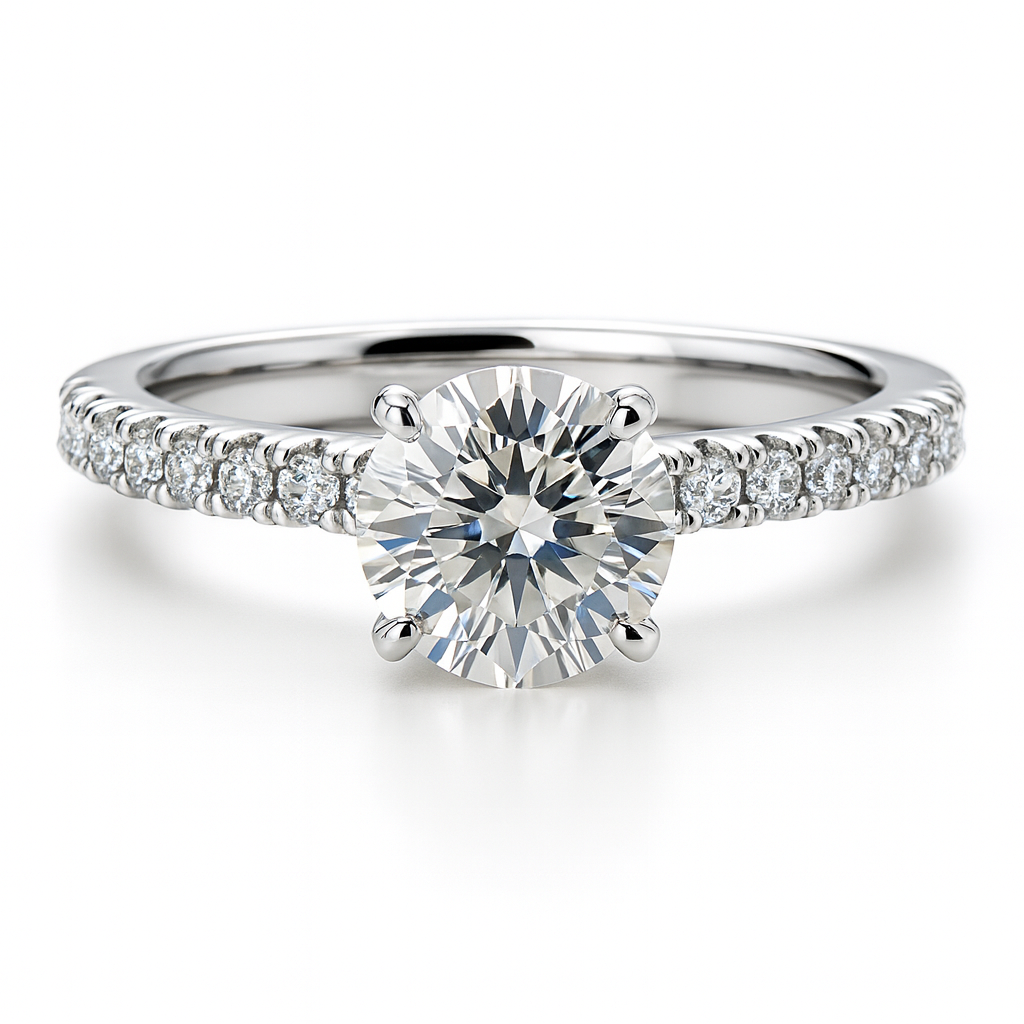
A moissanite carat size chart converts a stone's diameter in millimeters into its diamond-equivalent weight (DEW): a 5 mm round is sold as 0.5 ct, a 6.5 mm round as 1 ct, and an 8 mm round as 2 ct. Because moissanite is lighter than diamond, the stone's real weight is a bit lower than the DEW figure, roughly nine-tenths of it. The size you see is what the millimeters say.
That last point is the whole reason this chart exists. Below you'll find the full table, how to read listings like "1ct (6.5mm)", and what each size actually looks like once it's on a finger or an ear.
Why moissanite is sized in millimeters, not carats
A carat is a unit of weight (0.2 grams), not size. With diamonds, weight and size line up predictably because every diamond has the same density, about 3.52 g/cm³. Moissanite (silicon carbide) is lighter, at about 3.21 g/cm³. So a moissanite cut to exactly the same dimensions as a diamond weighs less.
If moissanite were sold by true weight, a "1 carat" moissanite would actually be bigger than a 1 carat diamond, and the numbers would confuse everyone. Instead, the industry uses diamond-equivalent weight: the stone is cut to the diameter of a diamond of that carat weight and labeled accordingly. When our listings say "1ct (6.5mm)" or "2ct (8mm)", that is DEW, and the millimeter number is the honest measurement of what you get.
If you want the bigger picture on how the two stones compare beyond size, our moissanite vs. diamond comparison covers sparkle, hardness and cost.
Round moissanite size chart: mm to carat
The DEW column below follows commonly published round brilliant diamond conversions for well-cut stones. The actual-weight column is our own calculation: DEW multiplied by the density ratio (3.21 ÷ 3.52 ≈ 0.91). Treat it as approximate. Real stones vary with cut proportions, crown height and girdle thickness, and many moissanites come in a little lighter than this simple ratio suggests.
| Diameter (round) | Diamond-equivalent weight (DEW) | Approx. actual moissanite weight* | How it's often listed |
|---|---|---|---|
| 3 mm | 0.10 ct | ≈ 0.09 ct | 0.1 ct |
| 3.5 mm | 0.17 ct | ≈ 0.16 ct | — |
| 4 mm | 0.25 ct | ≈ 0.23 ct | 0.25 ct |
| 4.5 mm | 0.36 ct | ≈ 0.33 ct | 0.3 ct |
| 5 mm | 0.50 ct | ≈ 0.46 ct | 0.5 ct |
| 5.5 mm | 0.66 ct | ≈ 0.60 ct | — |
| 6 mm | 0.84 ct | ≈ 0.77 ct | 0.8 ct |
| 6.5 mm | 1.00 ct | ≈ 0.91 ct | 1 ct |
| 7 mm | 1.30 ct | ≈ 1.19 ct | 1.25 ct |
| 7.5 mm | 1.67 ct | ≈ 1.52 ct | 1.5 ct |
| 8 mm | 2.00 ct | ≈ 1.82 ct | 2 ct |
| 8.5 mm | 2.43 ct | ≈ 2.22 ct | 2.5 ct |
| 9 mm | 2.75 ct | ≈ 2.51 ct | 3 ct (commonly rounded up) |
| 9.5 mm | 3.35 ct | ≈ 3.05 ct | 3–3.5 ct |
| 10 mm | 3.87 ct | ≈ 3.53 ct | 4 ct |
| 11 mm | 4.91 ct | ≈ 4.48 ct | 5 ct |
*Calculated from density alone (DEW × 0.91), rounded. Not a measured weight.
A note on the 9 mm row, because honesty matters here: diamond charts usually place a 9 mm round closer to 2.75 ct, but moissanite sellers commonly list 9 mm as "3ct". The same kind of rounding shows up at other sizes from seller to seller. That's exactly why the millimeter figure is the one to trust when you compare.
How our listings map to the chart
Here's how the round sizes in our catalog line up:
- 0.1 ct (3 mm), 0.3 ct (4.5 mm), 0.5 ct (5 mm), 1 ct (6.5 mm): the four size options on the Radiance Stud Earrings.
- 0.5 ct (5 mm): the center stone of the Heirloom Crown Two-Tone Ring.
- 0.5 ct (5 mm), 1 ct (6.5 mm), 2 ct (8 mm): the pendant options on the Timeless Round-Cut Necklace.
- 1 ct (6.5 mm), 2 ct (8 mm): the center stone options on Queen's Bloom, a round center in a floral halo.
- 2 ct (8 mm): the center of The Signature Ring.
- 3 mm, 4 mm, 5 mm (about 0.10, 0.25 and 0.50 ct each): individual stone sizes in our tennis necklaces, such as the Eternal Glow 3 Claw Tennis Necklace.
Every one of those carat figures is DEW. If you weighed the loose stones, you'd see slightly smaller numbers, as in the table above.
Fancy shapes: oval, pear, emerald and heart
Non-round stones are described by length × width, and conversions vary more because shapes differ in depth and outline. Rather than give a universal chart we can't stand behind, here are the fancy-shape sizes stated in our own listings:
| Shape | Listed size | Listed as | Approx. actual weight* | Where you'll find it |
|---|---|---|---|---|
| Oval | 9 × 7 mm | 2 ct | ≈ 1.8 ct | Solitaire Engagement Ring |
| Pear | 8 × 5 mm | 1 ct | ≈ 0.9 ct | Balance Duo Necklace |
| Emerald | 8 × 6 mm | 2 ct | ≈ 1.8 ct | Balance Duo Necklace |
| Emerald or radiant | 10 × 8 mm | 4 ct | ≈ 3.6 ct | Lumière Royale Emerald Ring |
| Heart | — | 1 ct or 2 ct | ≈ 0.9 / 1.8 ct | The Signature Heart Ring |
| Heart | 6 mm | 0.8 ct | ≈ 0.7 ct | The Luxora Heart Trilogy Bracelet |
| Cushion | 6.5 mm / 6 mm | 1.0 ct / 0.8 ct | ≈ 0.9 / 0.7 ct | Radiant Elegance Necklace & Bracelet |
*Again, DEW × 0.91, rounded. Approximate.
Two practical observations about shapes. Elongated cuts like ovals and pears tend to look larger face-up than a round of the same carat weight, because their length draws the eye and they often carry less weight hidden in depth. Step cuts like the emerald show a hall-of-mirrors look rather than sparkle, and with a doubly refractive stone like moissanite you may notice some facet doubling in larger step-cut stones when you look through them at an angle. Our guide to the best cut for moissanite goes deeper into how each shape behaves.
What looks good on a finger
There's no single right size, but some general patterns help:
- 5 mm (0.5 ct DEW): delicate and easy to wear every day. Reads as a refined accent on most hands, and suits stacking with bands.
- 6.5 mm (1 ct DEW): the classic solitaire size. Clearly visible across a table without feeling heavy, which is why it's such a common starting point.
- 8 mm (2 ct DEW): a confident, noticeable stone. On slimmer fingers it can cover much of the finger's width; on larger hands it looks balanced.
- 9 mm and up (3 ct DEW listing and larger): statement territory. Moissanite makes these sizes far more attainable than diamond, so it's tempting to go big; just consider whether you'll enjoy wearing it daily.
Finger width matters as much as stone size. The same stone looks larger on a size 4.5 finger than on a size 8, so if you're torn, picture the stone's width against the finger's width rather than thinking in carats. A halo also makes the overall look wider. If you're still deciding on a ring, our moissanite engagement ring buying guide walks through setting, band width and budget together.
And because sizes and ring sizes need to be right the first time, measure carefully. Our guide on how to measure ring size at home covers the reliable methods, and you can always email service@furmanluxury.com before ordering if you're unsure.
What looks good on an ear
Earrings are judged at a distance, so sizes read smaller than they do on a hand:
- 3 mm (0.1 ct): a tiny glint. Lovely for second or third piercings and for people who want something barely-there.
- 4.5–5 mm (0.3–0.5 ct per ear): the everyday sweet spot for many people. Noticeable sparkle, never loud.
- 6.5 mm (1 ct per ear): a clear, classic statement stud. Pairs well with evening wear and still works by day.
Earlobe size and hairstyle play a part too. Our moissanite stud earrings guide covers face shape, backs and metal in more detail.
Reading a moissanite listing with confidence
When you compare moissanite anywhere, a quick checklist keeps things clear:
- Look for the millimeters first. That is the size you'll see.
- Treat the carat number as DEW unless the seller says it's actual weight.
- Expect rounding at larger sizes, like the 9 mm "3ct" listing.
- For fancy shapes, check both dimensions, since a long, narrow oval and a wider one can carry the same carat label.
- Remember the setting. Prongs, halos and band width change how big a stone looks as much as a half-millimeter does.
Our stones are listed as D color and VVS1 clarity with an excellent cut, and eligible items ship with a GRA moissanite certificate describing the stone's stated grade. If you'd like to understand what those grades mean, see our explainer on moissanite color and clarity grades.
Finding your size
If you already know the look you want, the easiest next step is to browse by category and compare sizes side by side. Our engagement rings include round, oval, emerald and heart center stones from 1 ct DEW upward, and the earrings collection has studs from 3 mm to 6.5 mm. Take your time, and use the millimeters as your guide.
Frequently asked questions
How many carats is a 6.5 mm moissanite?+
A 6.5 mm round moissanite is sold as 1 carat diamond-equivalent weight (DEW), because a well-cut 1 ct round diamond measures about 6.5 mm across. Moissanite is lighter than diamond, so the stone itself weighs a little less, roughly 0.85 to 0.9 ct depending on its proportions. It looks like a 1 ct diamond face-up.
What does DEW mean on a moissanite listing?+
DEW stands for diamond-equivalent weight. It tells you what a diamond of the same diameter would weigh, so you can compare sizes at a glance. Because moissanite is less dense than diamond, the actual weight on a scale is lower than the DEW figure.
Why do moissanite sellers list stones by millimeters?+
Millimeters describe what you actually see: how wide the stone is face-up. Carat is a weight, and since moissanite and diamond have different densities, the same carat number means different sizes for each. The mm figure is the most reliable way to compare.
Is a 9 mm moissanite really 3 carats?+
Close, but it depends on the chart. Many diamond charts put a 9 mm round nearer 2.75 ct, while moissanite sellers commonly round 9 mm up to a 3 ct listing. If an exact size matters to you, go by the millimeter measurement.
Do oval and pear moissanite look bigger than round?+
Elongated shapes usually look larger for their carat weight than a round stone, because more of their weight is spread across the face-up area and their length draws the eye. That is one reason ovals are popular for engagement rings.
Related guides
Latest News
November 2, 2026
November 2, 2026
November 2, 2026
November 2, 2026
November 2, 2026