


Moissanite vs Lab Grown Diamond: An Honest Side-by-Side
• 7 min read
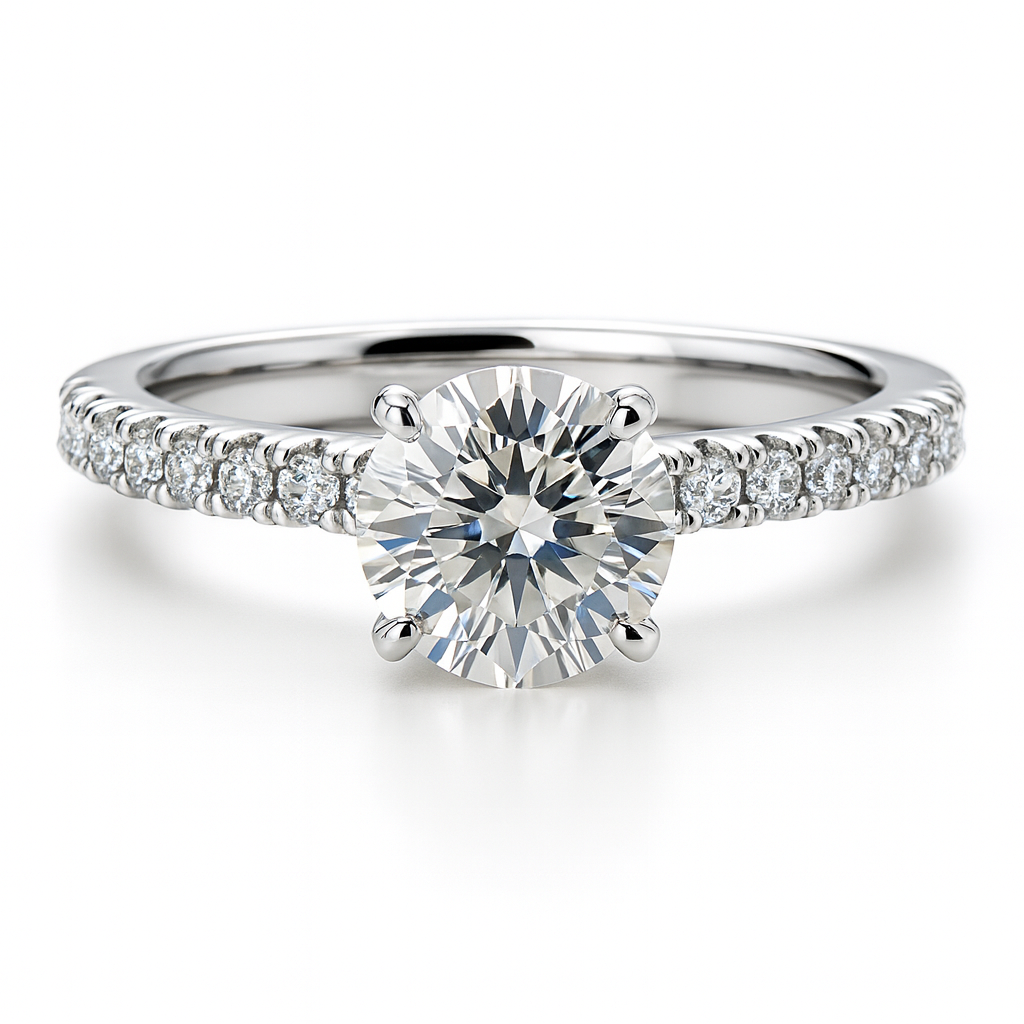
Moissanite and lab-grown diamond are both made in a lab, but they are different materials. A lab-grown diamond is real diamond (carbon, 10 on the Mohs hardness scale), while moissanite is silicon carbide (about 9.25) with noticeably more rainbow fire. Lab-grown diamond wins on hardness, identity and independent grading; moissanite usually wins on price, especially at larger sizes.
That is the short answer. The longer one is worth a few minutes if you are choosing a stone you plan to wear every day for years, because the right choice depends on what matters most to you.
What each stone actually is
Lab-grown diamond
A lab-grown diamond is diamond. It has the same chemistry, crystal structure and physical properties as a mined diamond; the only difference is where it formed. Producers grow them using high-pressure, high-temperature (HPHT) presses or chemical vapor deposition (CVD). There is nothing you can see by eye that separates a lab-grown diamond from a mined one, and gemologists need specialized instruments to confirm its origin.
Moissanite
Moissanite is silicon carbide (SiC). Henri Moissan found tiny natural crystals in 1893 in material from the Canyon Diablo meteorite site in Arizona. He first thought they were diamond; they were identified as silicon carbide around 1904. Natural moissanite is far too rare to supply jewelry, so all gem moissanite is lab-created, and gem-quality stones reached the market in the late 1990s (Charles & Colvard, 1998). If you want the full background, our plain-English guide to what moissanite is covers it.
So the fair framing is this: a lab-grown diamond is a diamond made by people. Moissanite is a different gem that looks similar, and in some ways behaves differently.
Moissanite vs lab-grown diamond at a glance
| Moissanite | Lab-grown diamond | |
|---|---|---|
| Material | Silicon carbide (SiC) | Carbon (diamond) |
| Hardness (Mohs) | About 9.25 | 10 |
| Refractive index | About 2.65–2.69 | About 2.42 |
| Dispersion ("fire") | About 0.104 | About 0.044 |
| Optics | Doubly refractive | Singly refractive |
| Density | About 3.21 g/cm³ | About 3.52 g/cm³ |
| Typical look | Very bright, strong rainbow flashes | Crisp white sparkle, softer color flashes |
| Grading | Seller grades, often with a GRA report | Independent labs such as GIA and IGI |
| Basic thermal tester | Usually reads as diamond | Reads as diamond |
| Multi-tester | Identified as moissanite | Reads as diamond |
| Relative price | Usually significantly lower | Higher, though it has fallen a lot |
Where lab-grown diamond wins
Hardness
Diamond sits at 10, the top of the Mohs scale. Moissanite, at about 9.25, is harder than sapphire (9) and almost every other gem used in jewelry, so it is a genuinely practical everyday stone. Still, the Mohs scale is a ranking, not an even ruler, and the step from 9 to 10 is a big one. Over many years of daily wear, a diamond keeps its facet edges crisp a little better than anything else.
It is diamond
For some people the word itself matters. If you, your partner or your family want the ring to be a diamond, only a diamond answers that. There is nothing shallow about it; it is simply a different priority, and a lab-grown diamond meets it at a lower price than a mined one.
Independent grading
Lab-grown diamonds are commonly graded by independent labs such as GIA and IGI, and the report number is often laser-inscribed on the stone's edge. Moissanite is usually sold with a GRA report. That report is useful as a record of the stone's stated grade, but GRA is not GIA and is not an independent lab of the same standing. We explain what those reports do and don't tell you in our guide to GRA moissanite certificates.
The look under strong lighting
This is the part people underestimate. Moissanite bends light more strongly than diamond and splits it into colors more than twice as much. In direct sunlight or under bright spotlights, that shows up as big, vivid rainbow flashes. Many people love it. Others feel it reads as "not quite diamond", especially in larger stones. A lab-grown diamond gives the whiter, more classic sparkle people picture when they think of a diamond. Indoors, in softer light, the difference is much smaller.
Testing and identification
A lab-grown diamond tests as diamond. Moissanite conducts heat well enough to read as "diamond" on many basic thermal testers, but multi-testers that also check electrical conductivity flag it as moissanite, and a gemologist can always tell. Our article on whether moissanite passes a diamond tester explains why. Either way, moissanite should be worn and gifted as moissanite, never passed off as something else.
Where moissanite wins
Price, especially as size goes up
Lab-grown diamond prices have dropped a lot in recent years, which has narrowed the gap. Even so, moissanite is usually significantly cheaper, and a lab-grown diamond of similar size and quality can easily cost several times more. The difference tends to widen as you move to two carats and beyond. Prices move quickly, so compare on the day you are buying, for the exact size and grade you want.
Fire and brightness
With a higher refractive index and more than double the dispersion, moissanite returns a lot of light and a lot of color. If rainbow sparkle is what draws you in, moissanite gives you more of it than any diamond.
Top color and clarity without trade-offs
Moissanite is produced to a consistent standard, and our stones are listed as D color, VVS1 clarity and excellent cut. With lab-grown diamond, price rises with each step up in color, clarity and size, so most budgets involve trade-offs. With moissanite you can usually have a near-colorless, eye-clean stone and the size you want at the same time. Our moissanite color and clarity grades guide explains what those grades mean.
Durability that is more than enough
At about 9.25, moissanite resists scratching very well, and it does not permanently cloud or change color. If it looks dull, that is surface residue such as oils, lotion or soap, and it cleans off.
Things that are the same, or close
- Both are lab-made. Neither involves mining the gem itself. Both take energy to produce, and environmental footprints vary by producer, so treat blanket "eco" claims about either one with healthy skepticism.
- Neither is an investment. Lab-grown diamond prices have fallen substantially, and moissanite is bought to be worn. Choose the stone you will enjoy, not the one you hope to sell.
- Both need cleaning. Any stone looks flat under a film of hand cream. Warm water, mild soap and a soft brush bring either back.
- Sizing works differently. Diamond is sold by carat weight. Moissanite is lighter than diamond, so it is sold by millimeter size or "diamond equivalent weight". A 6.5 mm round looks like a 1 ct diamond but the moissanite itself weighs roughly 0.85–0.9 ct. That is why our listings say "1ct (6.5mm)" or "2ct (8mm)". The moissanite carat size chart lays out the common sizes.
How to choose
Choose a lab-grown diamond if:
- it matters to you that the stone is diamond,
- you want the hardest possible stone,
- you prefer whiter, more classic sparkle, especially in bright light,
- you want an independent GIA or IGI report,
- the price for your preferred size fits your budget comfortably.
Choose moissanite if:
- you want a larger look within the same budget,
- you love strong, colorful fire,
- you want top listed color and clarity without trading down on size,
- you would rather put the difference toward something else. Our guide on how much to spend on an engagement ring may help you think that through.
If you can, look at both in person, in daylight and indoors. Your own eyes are the best tiebreaker.
One more honest note about our pieces: Furman Luxury settings are 925 sterling silver plated in 18K or 14K gold, not solid gold. Plating can wear over time with friction and chemicals, so take your ring off for the gym, swimming and cleaning, and keep perfume and lotion away from it.
Find the stone that suits you
If moissanite feels right, our engagement ring collection is a good place to compare shapes and sizes. The Luna Oval Cut Engagement Ring comes in 1–4 ct, and The Signature Ring pairs a 2 ct (8 mm) round with a pavé band. For promise and proposal pieces beyond solitaires, browse Love & Proposals. Shipping is free worldwide. Because wrong-size returns aren't accepted, measure the ring size carefully (or have it professionally measured) before you order, and read our return policy for what is eligible.
Frequently asked questions
Can you tell moissanite from a lab grown diamond by eye?+
Often not at a glance, especially in smaller stones and soft indoor light. In bright sunlight, moissanite tends to show bigger, more colorful rainbow flashes, and a trained eye may spot facet doubling when looking at an angle. A jeweler with the right instruments can always tell them apart.
Is a lab grown diamond more durable than moissanite?+
Yes, slightly. Lab-grown diamond is diamond, at 10 on the Mohs scale, while moissanite is about 9.25. Moissanite is still harder than almost every other gem used in jewelry and holds up very well to everyday wear, but diamond keeps sharp facet edges a little better over decades.
Which is cheaper, moissanite or lab grown diamond?+
Moissanite is usually significantly cheaper, and the gap tends to grow as stones get larger. Lab-grown diamond prices have fallen a lot in recent years, so it is worth comparing current prices for the exact size and quality you want.
Do lab grown diamonds and moissanite come with certificates?+
Lab-grown diamonds are commonly graded by independent labs such as GIA and IGI. Moissanite is usually sold with a GRA report, which describes the stone's stated grade but is not issued by a lab of GIA's standing and is not an appraisal of value. Eligible Furman Luxury pieces include a GRA moissanite certificate.
Will moissanite or lab grown diamond hold its value?+
Neither is a good investment. Lab-grown diamond prices have dropped substantially, and moissanite is bought for wearing, not reselling. Choose the stone you will enjoy looking at every day.
Related guides
Latest News
November 2, 2026
November 2, 2026
November 2, 2026
November 2, 2026
November 2, 2026