


Moissanite vs White Sapphire: Sparkle, Durability and Care
• 6 min read
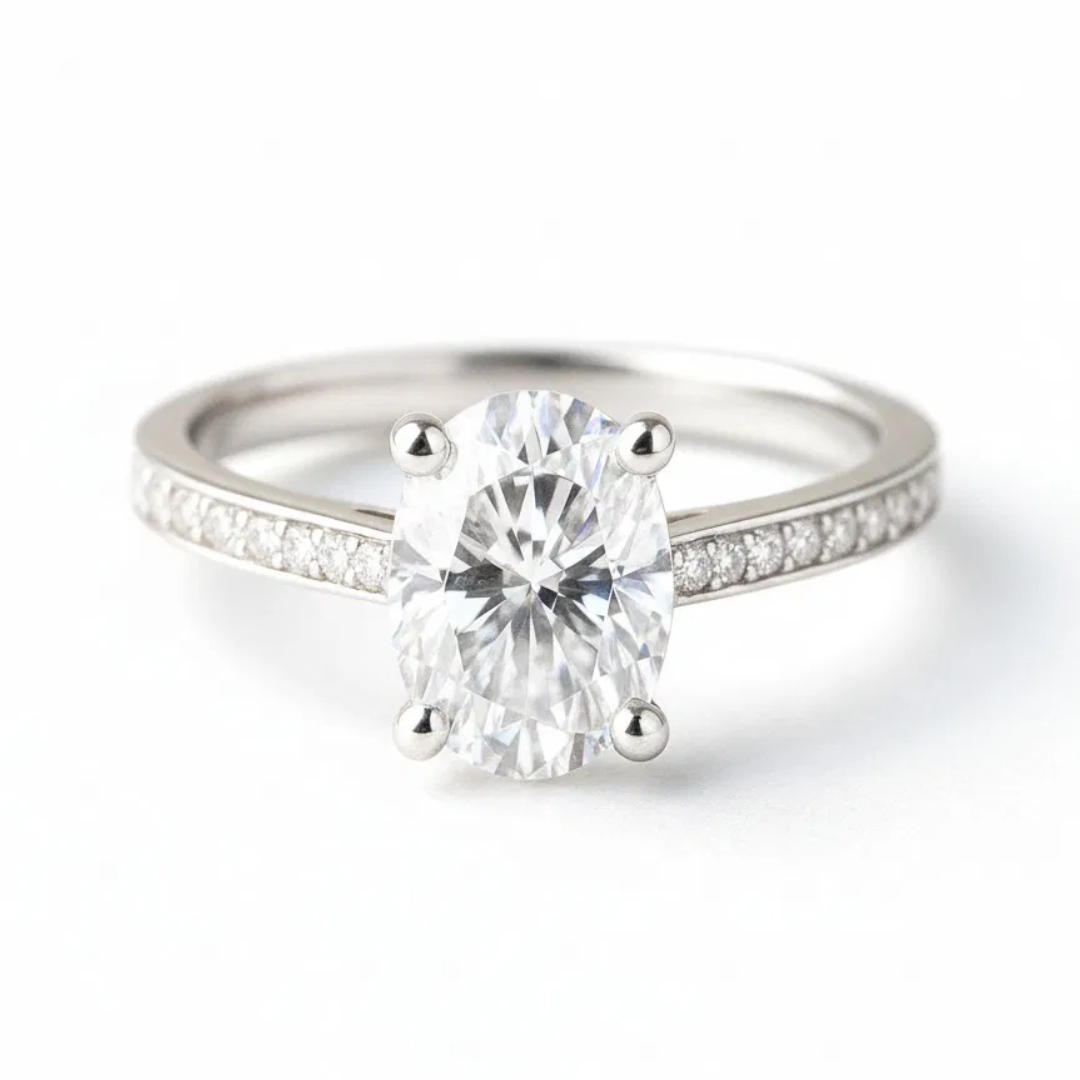
Moissanite and white sapphire are both hard, durable stones for everyday rings, but they look very different. Moissanite (about 9.25 on the Mohs scale) is far brighter and shows strong rainbow fire, while white sapphire (9 on the Mohs scale) has a soft, glassy glow with little fire and can look cloudy when it isn't clean. If you want sparkle, moissanite wins; if you want something quiet and understated, white sapphire may suit you better.
Below is a fuller comparison, including how each stone behaves after years of wear and what that means for upkeep.
What each stone is
White sapphire is colorless corundum, the same mineral as blue sapphire and ruby, just without the trace elements that give them color. It can be natural or lab-grown. Natural white sapphires are often heat-treated to improve their appearance, and lab-grown corundum has been produced since the early 1900s, so lab white sapphire is widely available and usually inexpensive.
Moissanite is silicon carbide. Natural moissanite is extremely rare, so all gem moissanite is lab-created. It was first found by Henri Moissan in 1893 in material from the Canyon Diablo meteorite site, and gem-quality stones reached the jewelry market in the late 1990s.
Both have long histories as diamond alternatives, but they appeal to quite different tastes.
Moissanite vs white sapphire at a glance
| Moissanite | White sapphire | |
|---|---|---|
| Material | Silicon carbide (SiC) | Corundum (aluminum oxide) |
| Origin | Always lab-created | Natural or lab-grown |
| Hardness (Mohs) | About 9.25 | 9 |
| Refractive index | About 2.65–2.69 | About 1.76–1.77 |
| Dispersion ("fire") | About 0.104 | Low (about 0.018) |
| Overall look | Very bright, lots of rainbow flashes | Soft, glassy, mostly white light |
| When dirty | Dulls, cleans back easily | Can look noticeably cloudy |
| Density | About 3.21 g/cm³ | About 4.0 g/cm³ |
| Price | Mid-range, well below diamond | Wide range: lab stones low, fine natural stones higher |
Sparkle: the real dividing line
If you only remember one thing, make it this: white sapphire does not sparkle the way moissanite or diamond does.
Refractive index tells you how strongly a stone bends light. A high number lets a well-cut stone send more light back up through its top. Moissanite's is about 2.65–2.69, even higher than diamond's 2.42. White sapphire's is about 1.76–1.77, which is much lower. In practice, a white sapphire returns less light and can show a slightly "see-through" area in the middle, especially in shallow cuts.
Dispersion is the stone's ability to split light into spectral colors, the flashes jewelers call fire. Moissanite's is about 0.104; white sapphire's is low, so you see very little color. Some people prefer that. White sapphire has a calm, icy look that suits vintage-style settings and anyone who finds strong rainbow sparkle too much.
How the difference shows in everyday light
Indoors, under warm lamps or office lighting, a clean white sapphire looks pleasant and bright in a gentle way, a little like polished ice. Moissanite in the same light looks noticeably livelier, with flashes of white light and some color as your hand moves. Outdoors in sunlight the gap widens: moissanite throws strong rainbow sparks, while white sapphire stays mostly white and calm. Neither look is wrong. It helps to picture where you will wear the piece most, and whether you want it to be noticed from a distance or enjoyed up close.
Durability: both are excellent
Here the two are close. White sapphire is 9 on the Mohs scale; moissanite is about 9.25. Both are harder than nearly every other gem used in jewelry, and both will shrug off the everyday knocks and grit that scratch softer stones like cubic zirconia (our moissanite vs cubic zirconia guide covers that comparison). Sapphire is also known as a tough stone that resists chipping well.
So durability shouldn't be the reason you choose one over the other. Look and upkeep are.
Upkeep: why white sapphire looks dirty sooner
Every gem collects a film of skin oils, lotion and soap. On a stone with high light return, like moissanite, a little film dulls the sparkle but the stone still looks lively. On white sapphire, which starts with less light return, the same film can make it look milky or cloudy quite quickly.
That cloudiness is usually residue, not damage, and it washes off. But white sapphire typically needs more frequent cleaning to look its best. Moissanite doesn't permanently cloud either; when it looks flat, a quick clean brings it back. Our guide to cleaning moissanite walks through the gentle method, which also works for white sapphire.
Price
Prices overlap, so it's worth comparing specific stones rather than assuming. Lab-grown white sapphire is usually inexpensive. Natural white sapphire varies a lot with size, clarity and treatment, and larger fine natural stones can cost more than you might expect. Moissanite sits in a middle tier: more than budget simulants, usually far less than diamond.
What you get for the money is different, too. Our moissanite is listed as D color, VVS1 clarity and excellent cut. With natural white sapphire, quality varies more from stone to stone, and some can carry a faint tint.
Weight and size
White sapphire is denser than moissanite (about 4.0 g/cm³ versus about 3.21), so a white sapphire of a given carat weight is smaller than a moissanite of the same weight. To compare fairly, compare millimeter measurements. Our moissanite listings give both: "1ct (6.5mm)" means a stone with the look of a 1 ct diamond, measuring 6.5 mm across. The moissanite itself weighs a little less than 1 ct, because it is lighter than diamond.
Which cuts work best for each
White sapphire benefits from cuts that maximize light return, typically deeper round brilliants or well-proportioned ovals. Step cuts like emerald can make its glassy character very obvious, which some people love for a vintage feel.
Moissanite has light to spare, so it looks good in almost any shape, though step cuts show its double refraction more clearly. Our guide to the best cut for moissanite goes through each shape.
Telling them apart
If you have an unmarked stone, the quickest clue is sparkle: a white sapphire looks noticeably calmer and glassier than moissanite under the same light. Moissanite usually reads as diamond on a basic thermal tester, and a multi-tester will identify it as moissanite. Looking through moissanite at an angle may also reveal doubled facet edges. A jeweler can confirm either stone in moments with standard instruments.
Who each stone suits
White sapphire may suit you if:
- you prefer a soft, understated glow to sparkle,
- you like the idea of a natural gemstone,
- you're happy to clean your ring often,
- you are drawn to vintage or antique-inspired designs.
Moissanite may suit you if:
- you want a bright, lively stone that reads as diamond-like from across a room,
- you love rainbow fire,
- you want consistent listed color and clarity,
- you want a stone that stays bright with less frequent cleaning.
If you are choosing for an engagement ring, our moissanite engagement ring buying guide covers settings, sizes and budget in one place.
Explore moissanite rings
If moissanite sounds like your stone, the Luna Oval Cut Engagement Ring offers 1–4 ct oval stones in white, yellow or rose gold plating. For a vintage feel, the Vintage Oval Elegance ring frames an oval with marquise and round side stones, and the Heirloom Crown Two-Tone Ring sets a 0.5 ct (5 mm) round in silver with gold accents. You can compare more styles across our engagement rings and Timeless Classics collections. Our settings are 925 sterling silver, plated rather than solid gold, so remove your ring for swimming, workouts and cleaning, and measure your ring size carefully before ordering, since wrong-size returns aren't accepted.
Frequently asked questions
Which sparkles more, moissanite or white sapphire?+
Moissanite, by a wide margin. Its refractive index is about 2.65 to 2.69 compared with about 1.76 to 1.77 for sapphire, and its dispersion is several times higher. White sapphire has a softer, glassier glow with very little rainbow fire.
Is white sapphire more durable than moissanite?+
Not in scratch resistance. White sapphire is 9 on the Mohs scale and moissanite is about 9.25, so both resist scratching very well. Sapphire is also a tough stone, so both are practical for everyday rings.
Why does white sapphire look cloudy?+
Because white sapphire returns relatively little light, a thin film of skin oil, lotion or soap makes a bigger difference to how it looks. It is usually residue rather than damage, and a gentle clean with warm water, mild soap and a soft brush restores it. It just tends to need cleaning more often to look its best.
Is white sapphire cheaper than moissanite?+
It depends. Lab-grown white sapphire is usually inexpensive, while natural white sapphire varies with size and quality, and larger fine natural stones can cost more. Moissanite sits in a similar general price range, so compare the specific stones you are considering.
Can you tell white sapphire from diamond?+
Usually, yes, once you know what to look for. White sapphire lacks diamond's brightness and colorful flashes, so side by side it looks calmer and more glassy. A jeweler can confirm it quickly with standard gem instruments.
Related guides
Latest News
November 2, 2026
November 2, 2026
November 2, 2026
November 2, 2026
November 2, 2026